Age calculator — how old, exactly?
Years, months and days — plus total days lived and a countdown to your next birthday.
- Born on a—
- Weeks lived—
- Hours lived—
- Turning next—
Exact age, to the day
Age in years is what forms ask for. Age in years, months and days is what actually describes how long someone has been alive, and the difference matters for development milestones and for anything with an age cutoff.
- Enter the date of birth. Any date in the past. The tool handles leap days correctly, which matters for people born on 29 February — their legal age advances on 28 February or 1 March depending on the jurisdiction.
- Leave the second date at today, or set it. Setting a different date answers "how old will I be on that day", which is the useful form for planning a birthday, a retirement date, or an eligibility cutoff.
- Read the breakdown. Years, months and days, plus the totals in months, weeks and days. The totals are what you need when a form asks for age in months, which is common for young children.
When this comes up
- Filling in a form that wants exact age. Visa applications, school admissions and some medical questionnaires ask for age in years and months, and rounding is not accepted.
- Checking an age cutoff. Whether someone is old enough on the day of an event, not on the day of registration, is a recurring problem in sport and in travel.
- Tracking a child’s development. Milestones in the first two years are measured in months, and the difference between 18 and 20 months is clinically meaningful.
- Working out a retirement or pension date. Setting the reference date forward shows exactly when a threshold is crossed.
A worked example: born 15 May 1990
On 1 November 2026 that is 36 years and 5 months, or 437 months, or 13,319 days. Three different numbers, all correct, answering three different questions — and which one you need depends on the form in front of you.
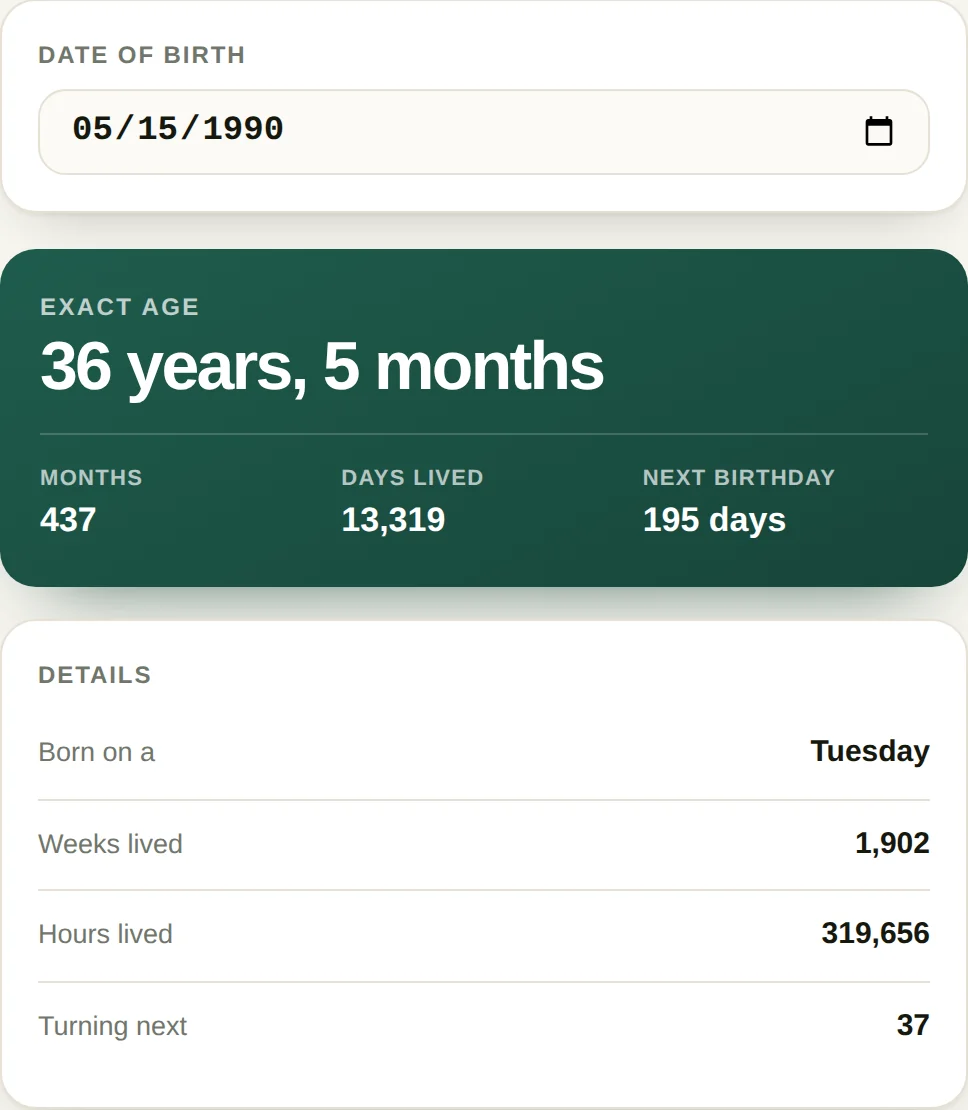
The months figure is the one people misread. It is not days ÷ 30.44; it counts completed calendar months, so it advances on the 15th of each month rather than every 30 days. That is why the same birthday can read as 437 months in one place and 438 in another: one counts elapsed months, the other rounds the partial one up.
Month-end birthdays are where the calendar gets awkward. Someone born on 31 January has no 31 February, so in most legal systems their age increments on 28 February in ordinary years and 29 February in leap years. Anyone born on 29 February gets a birthday on 28 February three years out of four, which matters for school cut-offs and licences far more often than you would expect.
Where age calculation goes wrong
- Time zone of birth. For a newborn the date of birth can differ by a day depending on the zone it is recorded in, and age-restricted services care about the day.
- "Years old" versus "in your 37th year". Legal and medical language counts completed years; some traditions count the year you are in.
- Month-end births shift the increment date, and forms that compare dates numerically will disagree with the human answer.
- Rounding the partial month. 36 years 5 months and 20 days is not "36 years 6 months" on any form that asks; truncating is the safer default.
Questions
How is age calculated for someone born on 29 February?
In most legal systems their age advances on 1 March in non-leap years, though some use 28 February. The underlying count of days is unaffected — only the anniversary date is ambiguous. For any calculation based on elapsed days rather than calendar years, there is no ambiguity at all.
Why is my age in months not exactly years × 12?
Because months vary between 28 and 31 days. Someone born on 31 January is not "one month old" on 28 February by a strict calendar reading, but is by most conventions. The month count here follows calendar months, which is what institutions mean when they ask.
Does the time of birth matter?
Only if you need age to the hour, which almost nothing does. Legal age, eligibility and medical milestones are all date-based. This tool works in whole days.
Can I calculate age at a past date?
Yes — set the second date to any point in the past. That answers "how old was this person when X happened", which comes up in historical research and in legal cases.
More date and time tools
Guides
No daily limit on this tool
This one is free with no counter — it runs in your browser and costs nothing to serve. All-Access is for the PDF and image tools, which are free three runs a day.
- Unlimited PDF and image jobs
- Full-length output, no page cap
- Every tool added later, included
- One payment, no subscription