BMI calculator — where your weight actually sits.
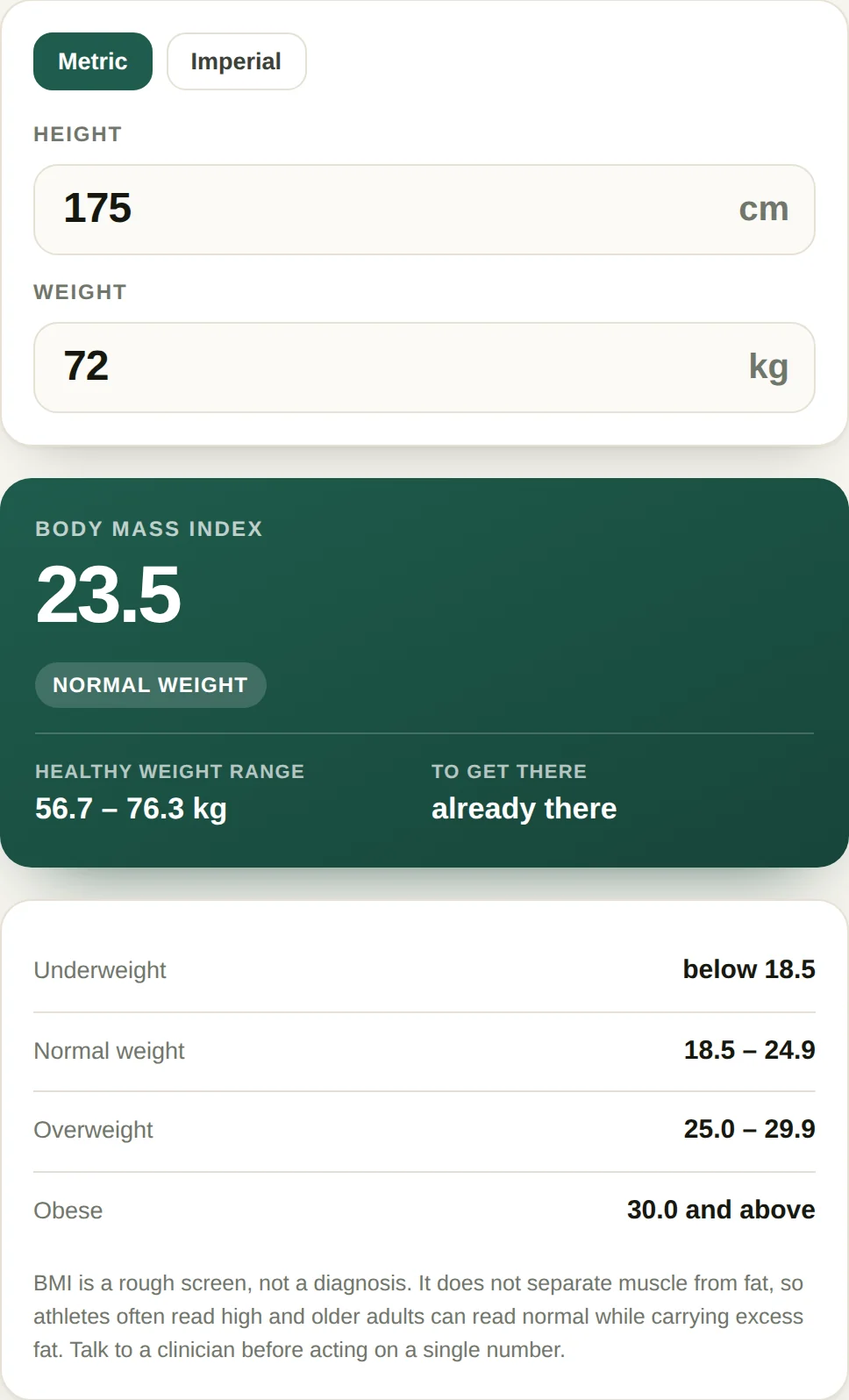
Body mass index, the range it falls into, and the healthy weight band for your height.
- Underweightbelow 18.5
- Normal weight18.5 – 24.9
- Overweight25.0 – 29.9
- Obese30.0 and above
BMI is a rough screen, not a diagnosis. It does not separate muscle from fat, so athletes often read high and older adults can read normal while carrying excess fat. Talk to a clinician before acting on a single number.
What BMI measures, and what it does not
BMI is a ratio of weight to height squared. It was designed as a population screening tool in the 1830s, and it is used individually today mainly because it is cheap. Knowing its limits makes the number more useful, not less.
- Enter your height and weight. Metric or imperial, whichever you know. The unit toggle converts the values you have already typed rather than clearing them, so switching does not mean starting again.
- Read the number and the band. The result places you in one of the standard categories. Those thresholds come from the World Health Organization and are the ones most health services use.
- Look at the healthy weight range. This is often more useful than the BMI itself: it tells you the weight band that would put you in the middle category at your height, which is a concrete target rather than an abstract score.
- Treat it as one input. BMI cannot tell muscle from fat, cannot see where fat is stored, and was not designed for individuals. It is a starting point for a conversation, not a diagnosis.
When this comes up
- A rough check before a doctor’s appointment. Useful context for a conversation, not a substitute for one.
- Tracking a direction over time. BMI’s real strength is comparability: the same person at two points in time, measured the same way, shows a trend that is meaningful even if the absolute number is imperfect.
- Understanding a threshold in a medical form. Insurance questionnaires and some clinical guidelines still use BMI bands, so knowing where you sit explains the questions being asked.
- Sanity-checking a weight goal. The healthy range at your height is a more grounded target than a number picked from a magazine.
A worked example: 175 cm and 72 kg
BMI is weight in kilograms divided by height in metres squared: 72 ÷ (1.75 × 1.75) = 72 ÷ 3.0625 = 23.5. That sits inside the normal band of 18.5–24.9, and the healthy weight range at 175 cm works out to 56.7–76.2 kg.
The number is a screening tool, not a diagnosis, and it is worth knowing where it fails. It cannot tell muscle from fat, so a 95 kg athlete at 180 cm reads as overweight at 29.3 with 12% body fat. It says nothing about where the fat sits, and visceral fat around the organs is the part that tracks metabolic risk. Waist-to-height — keep your waist under half your height — is cruder and catches much of what BMI misses.
Cut-offs also differ by population. The 25 threshold is built on European data; for people of South Asian, Chinese and Japanese descent risk rises at lower BMIs, and 23 and 27.5 are the usual action points. An adult at 24.5 is "normal" on the default scale and above the recommended threshold on the appropriate one.
Where BMI goes wrong
- Children are not measured on this scale. Under 18, BMI is read against age-and-sex percentile charts, where a number that is normal for an adult can be a flag for a child.
- Pregnancy, amputation and significant height loss break the formula outright rather than bending it.
- Self-reported height runs high. Two centimetres of optimism moves BMI by about 0.5 — enough to cross a threshold.
- Tracking it weekly. BMI moves with hydration and glycogen. Month-to-month direction is signal; day-to-day is noise.
Questions
Why is BMI criticised?
For three concrete reasons. It cannot distinguish muscle from fat, so athletes are often classified as overweight. It ignores where fat is stored, and visceral fat around the organs carries more risk than fat elsewhere. And the thresholds were derived mainly from European populations, so they fit some bodies better than others.
What are the BMI categories?
Under 18.5 is underweight, 18.5 to 24.9 is the healthy range, 25 to 29.9 is overweight, and 30 and above is obese, subdivided further into classes. These are WHO figures for adults; children are assessed on growth percentiles instead, which is a different calculation entirely.
Should athletes use BMI?
Only with a large discount. A rugby player and a sedentary person of the same height and weight can have the same BMI and completely different body composition. Waist-to-height ratio is a better single number for muscular people, because it responds to where fat is rather than how much total mass there is.
Does BMI work the same for everyone?
No. Several health bodies use lower thresholds for people of South Asian descent, because the metabolic risk associated with a given BMI is higher. Older adults also tend to carry more fat at the same BMI than younger adults. The number means slightly different things in different bodies.
More everyday tools
Guides
No daily limit on this tool
This one is free with no counter — it runs in your browser and costs nothing to serve. All-Access is for the PDF and image tools, which are free three runs a day.
- Unlimited PDF and image jobs
- Full-length output, no page cap
- Every tool added later, included
- One payment, no subscription