Case converter — fix the capitalisation.
Headlines, variable names, slugs — paste once, click a style, copy the result.
7 words · 43 characters
Seven text cases, and when each one is correct
Case conversion looks like a formatting convenience until you are naming variables or fixing a headline. The rules for title case in particular are not "capitalise every word", and getting them wrong is visible to anyone who edits for a living.
- Paste or type your text. Conversion applies instantly to the whole text. Nothing leaves the browser.
- Pick the case you need. Each button applies one transformation. The result replaces the input so you can copy it directly or chain another transformation on top.
- Check title case specifically. This one follows the editorial convention: capitalise the first and last word and all significant words, but leave articles, short prepositions and conjunctions lowercase unless they start or end the title. "The Old Man and the Sea", not "The Old Man And The Sea".
- Copy the result. One button, and the text is on your clipboard ready to paste into the destination.
When this comes up
- Writing a headline or an article title. Title case conventions are inconsistently applied across the web, which is exactly why doing it properly is noticeable.
- Naming variables and files. camelCase, snake_case, kebab-case and PascalCase are conventions with real audiences: JavaScript, Python, CSS and class names respectively.
- Fixing text pasted in caps lock. Someone sends a paragraph in block capitals; sentence case restores it without retyping.
- Cleaning up data. Normalising a column of names or emails to one case before importing it somewhere that is case-sensitive.
A worked example: one phrase, seven cases
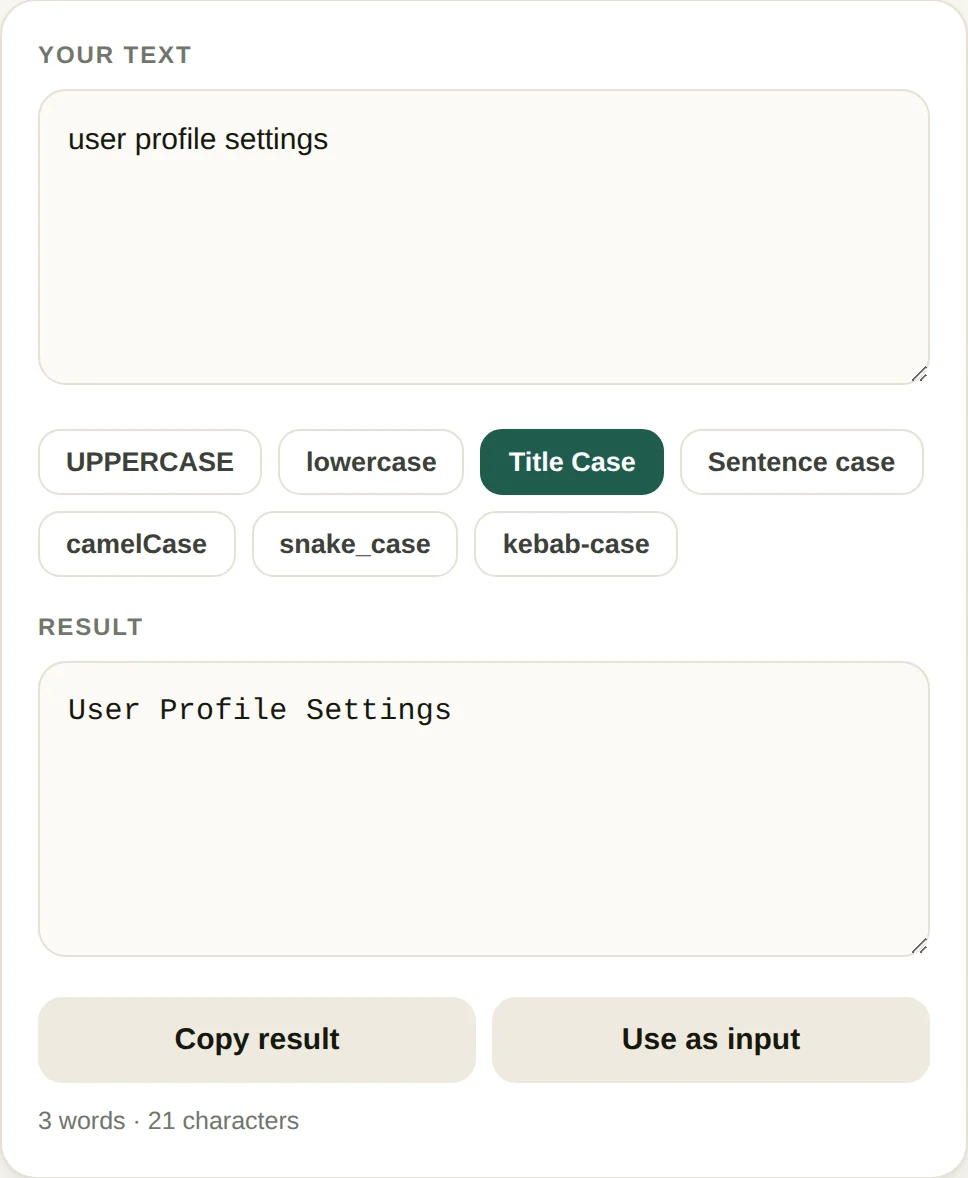
Starting from "user profile settings", the conversions are:
| Case | Result | Where it belongs |
|---|---|---|
| UPPERCASE | USER PROFILE SETTINGS | labels, warnings |
| lowercase | user profile settings | data normalisation |
| Title Case | User Profile Settings | headings, buttons |
| Sentence case | User profile settings | UI copy, body text |
| camelCase | userProfileSettings | JavaScript, Java |
| snake_case | user_profile_settings | Python, SQL, JSON keys |
| kebab-case | user-profile-settings | URLs, CSS classes |
The convention that trips people up is acronyms. Naive camelCase turns "API key" into "ApiKey" and "user ID" into "UserId", destroying the information that these were initialisms. Most style guides settle on "apiKey" for the identifier and "API key" for the label, and no automatic converter can know which you meant — that one needs a human pass.
Title case has rules that differ by publisher. Chicago capitalises prepositions of five letters or more ("Between") but not shorter ones ("of", "to"); AP capitalises everything above three letters. Either is defensible. Mixing them in one document is not.
Where case conversion goes wrong
- Leading digits. "2fa settings" becomes "2faSettings", which is not a valid identifier in most languages. Prefix it, or spell the number out.
- Accents and ligatures. "café" may come out as "cafe" or "caf_", depending on whether the converter transliterates. Neither is safe for an identifier without checking.
- kebab-case is for URLs, snake_case for keys. Using snake_case in a URL is legal but reads like an internal path; kebab-case in JSON is legal but inconsistent with nearly every API you will consume.
- Case-insensitive systems hide the damage. Changing the case of an email address or a database key can silently create duplicate records on a case-sensitive store.
Questions
Which words stay lowercase in title case?
Articles (a, an, the), coordinating conjunctions (and, but, or, for, nor, so, yet) and prepositions of four letters or fewer (at, by, for, in, of, on, to, up, with is usually capitalised). The first and last word of the title are always capitalised regardless of what they are.
What is the difference between camelCase and PascalCase?
camelCase starts lowercase and capitalises each subsequent word: firstName. PascalCase capitalises the first word too: FirstName. Both are used in programming, in different contexts — PascalCase for classes and types in many languages, camelCase for variables and functions.
When would I use snake_case versus kebab-case?
snake_case (words_with_underscores) is the Python and SQL convention and works everywhere in code. kebab-case (words-with-hyphens) is the CSS and URL convention, and is the safer choice for file names because it avoids case-sensitivity issues across operating systems.
Does sentence case capitalise proper nouns?
It should, but this tool cannot reliably tell a proper noun from an ordinary word without a dictionary, so it lowercases everything except the first letter. Check names and places afterwards — it is a shorter fix than retyping the paragraph.
More text tools
Guides
No daily limit on this tool
This one is free with no counter — it runs in your browser and costs nothing to serve. All-Access is for the PDF and image tools, which are free three runs a day.
- Unlimited PDF and image jobs
- Full-length output, no page cap
- Every tool added later, included
- One payment, no subscription