Stock profit calculator — what the trade actually made.
Entry, exit, shares and fees. It returns net profit, the break-even price, and the return on the money you had to put up.
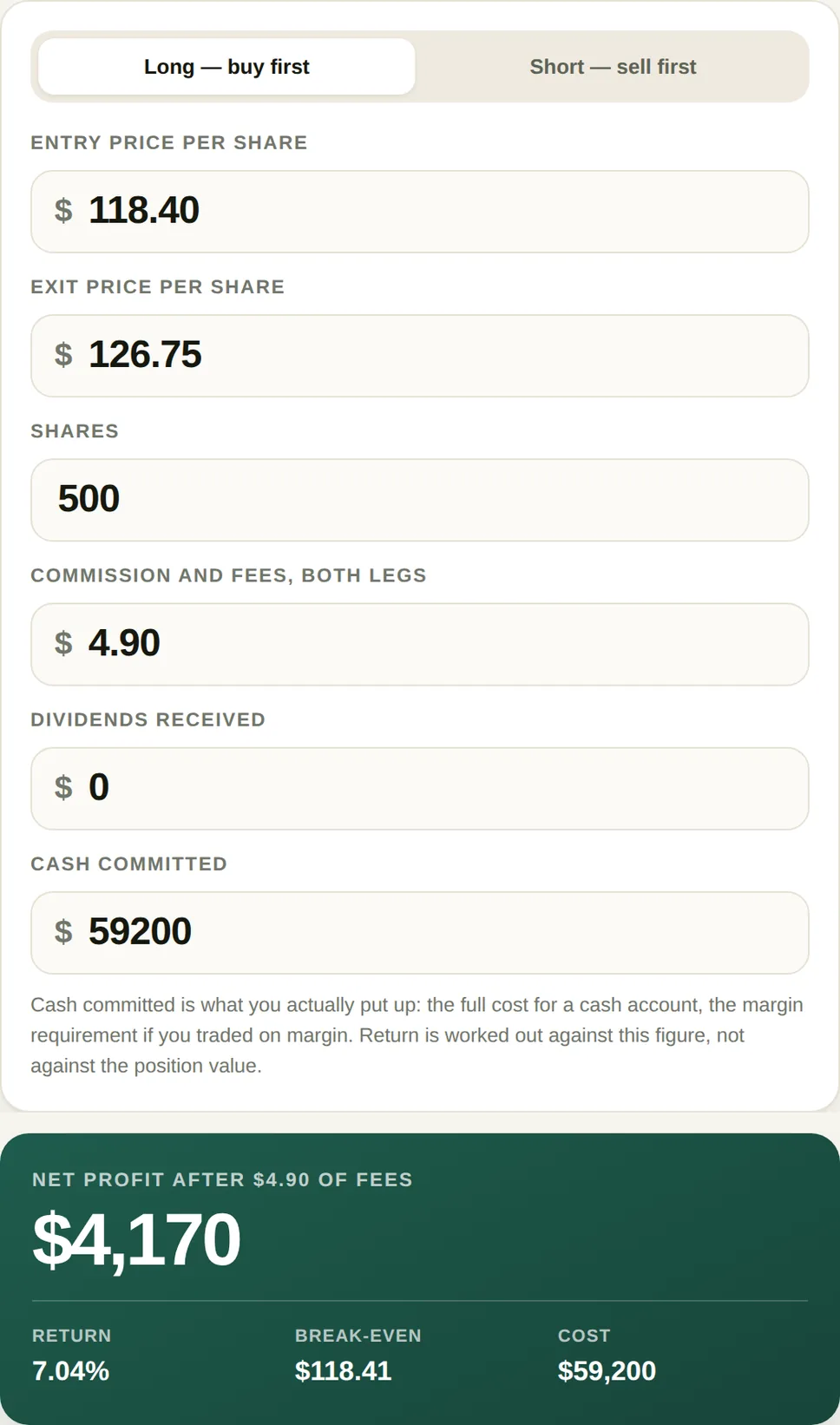
Cash committed is what you actually put up: the full cost for a cash account, the margin requirement if you traded on margin. Return is worked out against this figure, not against the position value.
The ladder is built from the same four numbers. Change the share count and every line moves with it.
What this calculates, and what it leaves out
Four inputs decide the answer: entry price, exit price, share count and total commission. Everything else on the page is derived from those. Net profit is the price change multiplied by the share count, minus commission and fees on both legs, plus any dividends you collected, minus the borrow fee if you were short. Return is net profit divided by the cash you committed, which is not the same as the position value once margin is involved. The result is before tax.
People usually arrive here after a broker app shows a round number that does not match their own arithmetic. The gap is almost always commission and the currency or regulatory fee that sits next to it. A $4.95 commission plus a $0.01-per-share SEC fee plus a small exchange fee looks like noise on a $59,000 trade. It is $9.80, and on 500 shares that is two cents a share — enough to move the break-even price above the price on the screen.
How to use it
- Pick the direction. Long if you bought first, short if you sold borrowed shares first. The tab changes the label on the price fields and which of the two costs applies: a long can receive dividends, a short owes them.
- Type the average entry and the average exit. Not the first fill and the last fill — the weighted average of all fills, and the share count that matches it. If you built the position in two lots, 300 shares at $112 and 200 at $118, the entry is $114.40 and the count is 500.
- Add every fee, not just the headline commission. Broker commission, exchange fees, stamp duty where it applies, and the per-share regulatory fee. A statement lists them separately; the total is what belongs in the field.
- Enter the cash you committed. For a cash account that is the full cost. For a margin account it is the equity you put up, typically 50% for a long in the United States, which doubles the return on a winning trade and doubles the loss on a losing one.
- Read the break-even line. If the exit price is below it, the trade is a loss after costs even when the share price went up. That single line catches more mistakes than the profit figure does.
A worked example: 500 shares, two days, $4.90 of fees
You buy 500 shares at $118.40 and sell them two days later at $126.75. The commission is $4.90 to get in and the same to get out, so the fee field holds $9.80 — but many brokers bill commission per leg while the regulatory fee is charged only on the sale, so check the statement rather than doubling blindly. With $9.80 of costs the figures are:
- Cost of the position: 500 × $118.40 + $4.90 = $59,204.90
- Proceeds: 500 × $126.75 − $4.90 = $63,370.10
- Gross profit: 500 × $8.35 = $4,175.00
- Net profit: $4,175.00 − $9.80 = $4,165.20
- Return on $59,204.90: 7.04%
- Break-even exit price: $118.40 + $9.80 / 500 = $118.42
Change one input and the picture changes. Drop the share count to 50 and the same 1.9% price move produces $417.50 gross, $407.70 net, and a return that has barely moved — but the fee is now 2.4% of the gross profit instead of 0.23%. Small positions are where commission quietly eats the trade. On a 50-share order at a broker charging $4.95 a leg, the price has to move about $0.20 a share before you are flat, which is the entire margin on a stock trading at $20.
Where the arithmetic goes wrong
The fee is applied to the position, not the share count. People divide the total commission by the share price instead of the share count, then wonder why the break-even is off by a dollar. Fees per share are total fees divided by shares; the share price never enters that division.
Shorting inverts two signs. On a short, the proceeds arrive at the start and the cost arrives at the end, so the cash committed is the margin requirement rather than the position value. A $50,000 short with 30% margin ties up $15,000, and a 10% adverse move costs $5,000 — a third of the capital, not a tenth. Entering the position value as cash committed makes every short look three times safer than it is.
Dividends and borrow fees are cash flows, not price changes. A short seller owes the dividend to the lender, and it is debited on the payment date whether or not the position was profitable. Borrow fees accrue daily and are quoted as an annual percentage, so a hard-to-borrow stock at 8% a year costs roughly 0.022% a day. Both belong in the cost fields; leaving them out overstates a short by whatever those two amounts happen to be.
Currency. Every figure here is in one currency. A trade in a foreign stock with a broker that settles in your home currency has a currency gain or loss on top of the price move, and that is not modelled. Convert the entry and exit at the rates your statement used if you want the number to match the statement.
Wash sales on the loss side. If this trade is a loss and you rebuy the same stock within thirty days, the loss may be disallowed for tax and added to the basis of the new shares. The calculator gives the pre-tax economic result; it does not decide whether you can use it.
Against the alternatives
A broker app shows the profit on the position, which is correct and useful and usually after its own fees but before anyone else's. A spreadsheet gives you exact control and takes ten minutes to build and another ten to trust. Desktop portfolio software will track every lot and every corporate action for a per-seat annual fee, which makes sense if you place a hundred trades a month and not if you place three. This page is for the middle: one trade, four numbers, an answer you can check by hand in under a minute.
Two related questions tend to follow a trade. If the gain is taxable, the split between short-term and long-term rates is what decides the bill — that is a holding-period question, not a profit question. If you are comparing the trade against a mortgage payment or a loan, the comparison only works on an annualised basis, because a 7% two-day trade and a 7% annual return are not the same thing.
Questions
Why is my break-even price above what I paid per share?
Because commission is charged on both legs. If you pay $4.90 to buy and $4.90 to sell, the position has to clear $9.80 before it is flat, which on 500 shares is $0.0196 a share. The break-even price is the entry price plus total fees divided by the share count. On cheap stocks that increment can swallow a whole percentage point.
How is a short position calculated differently?
The profit formula mirrors: you gain when the exit price is below the entry price. Two costs also appear that a long does not have. You owe any dividend paid while the position is open, and you pay borrow fees to the lender, usually quoted as a percentage a year and charged daily. Both are entered as cash costs and subtracted from the profit.
Does it handle partial fills at different prices?
It takes a single average entry and a single average exit, which is what a broker statement shows you anyway. For a position built at $112 for 300 shares and $118 for 200 shares, enter the weighted average of $114.40 and the total of 500 shares. The unweighted average of the two prices gives a wrong answer whenever the two lots were different sizes.
Should return be measured against cost or against margin?
Against margin, if you actually used margin, because that is the money that was at risk. Buying $59,200 of stock with $29,600 of your own cash and doubling the gain also doubles the loss. Both figures are shown so you can see how much the borrowed half is doing.
Where do dividends belong?
In the dividend field, as total cash received while you held the shares, before withholding tax. A $0.92 quarterly dividend on 500 shares is $460 if you held through one payment. Keeping it separate from the price change matters because dividends are taxed at different rates in most countries.
Are taxes included?
No. The figure is pre-tax. Tax depends on your holding period and your bracket, and it is different again for a short. If you want an after-tax number, run the result through a capital gains calculator with your own rates rather than guessing at a rate here.
More money tools
No daily limit on this tool
This one is free with no counter — it is arithmetic, and it runs in your browser. All-Access is for the PDF and image tools, which are free three runs a day.
- Unlimited runs on the file tools, full-length output
- Every other tool included, and everything added later
- No counter, no ads, no tracking