Word counter — how long is this, really?
Paste text below. Counts update as you type, and nothing is sent anywhere.
- Characters without spaces0
- Average word length0
- Reading time (225 wpm)0s
- Speaking time (130 wpm)0s
Reading speeds vary a lot. 225 words per minute is a common silent-reading average; 130 is a comfortable pace for reading aloud to an audience.
Counting words, characters and reading time
Different platforms count differently, and the differences are not trivial: a 500-word limit on one site may be a 560-word count on another because of how hyphens and numbers are treated. This tool shows the components so you can see where the gap comes from.
- Paste your text. Everything is counted as you type. Nothing is sent anywhere — the text stays in the browser tab, which matters if it is unpublished work or anything confidential.
- Read the word count first. Words are split on whitespace, which is the convention nearly every editor and submission system uses. Hyphenated words count as one.
- Check characters with and without spaces. Both numbers are shown because both are used as limits: Twitter counts characters, some meta description fields count without spaces, and academic abstracts vary.
- Use the reading time. Based on 200–250 words per minute for silent reading, which is the range most publishing guidelines assume. Speaking is slower, closer to 130–150 words per minute.
When this comes up
- Hitting a word limit. University applications, journal submissions, scholarship essays and freelance briefs all impose limits, and being 40 words over is a real problem.
- Writing a meta description or an ad. Character limits are hard cutoffs in search results and in ad platforms, and cutting a sentence afterwards usually damages it.
- Estimating how long a talk will take. A 1,500-word script is about ten minutes spoken. Knowing this before writing the slides is better than discovering it at rehearsal.
- Checking density in a document. Sentence count and average sentence length are the two numbers editors use to judge readability without running a full readability score.
A worked example: a paragraph, counted
Eighteen repetitions of "The quick brown fox jumps over the lazy dog" give 162 words, 809 characters, 18 sentences and 1 paragraph. Nine words per sentence and forty-five characters per sentence is a useful calibration point: ordinary English runs 15–20 words a sentence, so this text reads as unusually clipped.
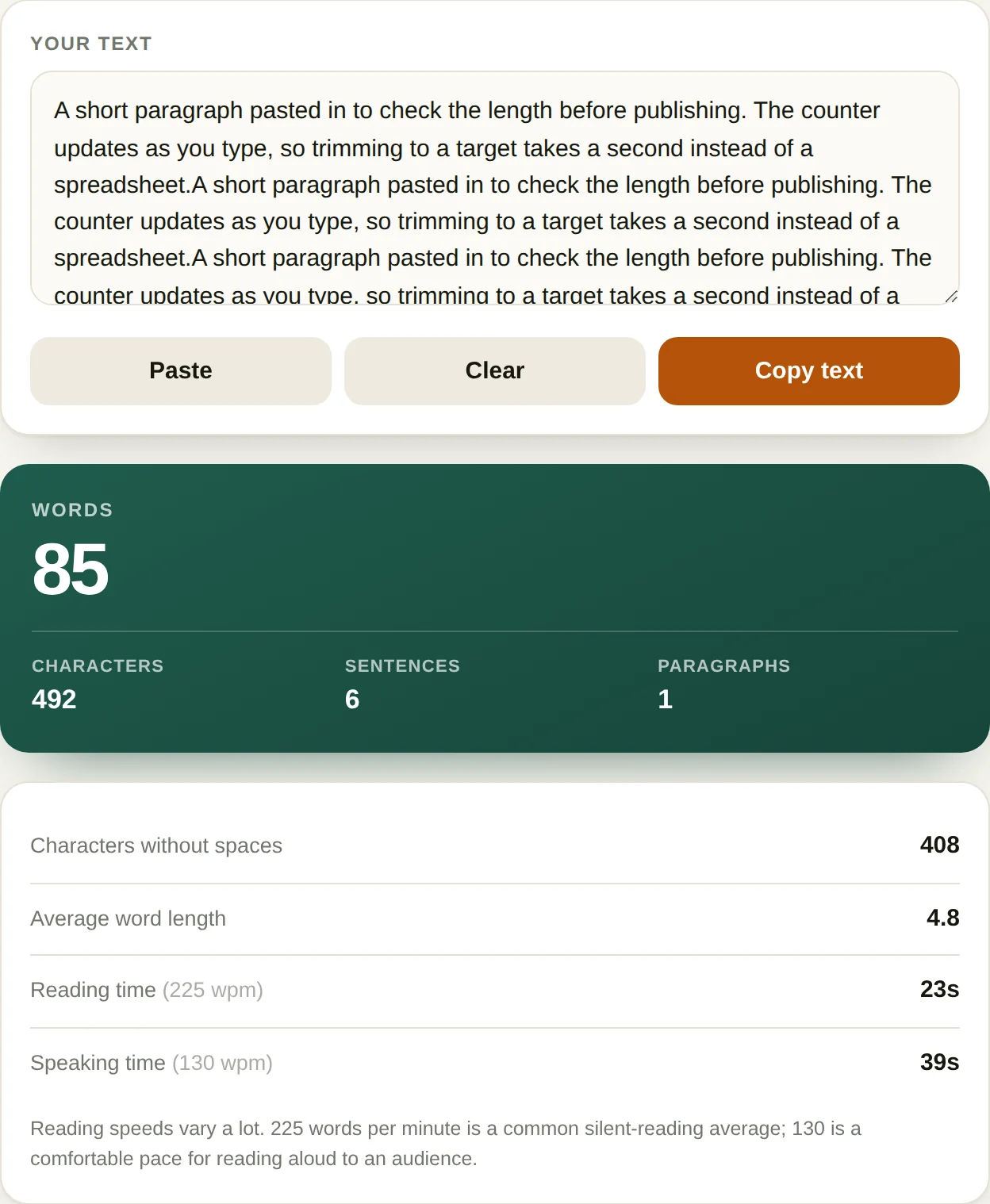
The character count includes spaces and the word count does not, and that gap is where most disagreements come from. Word counts a hyphenated compound as one word; so does a script splitting on whitespace. The divergences appear with em dashes, ellipses, URLs, file paths and numbers — "2026-11-01" is one token to some tools and three to others.
Reading time is the derived figure people quote without checking. At 200–250 words a minute, 162 words is under a minute and a 1,200-word article is five to six. The 238 wpm cited in reading-time plugins comes from averages across silent reading of expository prose, and it is optimistic for anything technical.
Where word counts go wrong
- CJK text has no spaces. A whitespace split returns one "word" for an entire Chinese paragraph. Character count is the meaningful measure there.
- Copy-paste from a PDF brings hard line breaks that split hyphenated words into fragments and inflate the count by a few percent.
- "300 words minimum" for SEO is a myth with a grain of truth. Length correlates with ranking because thorough pages tend to be long, not because length is a ranking factor.
- Scope differs. Word counts headers, footers and text boxes when asked; a browser counts what is in the DOM. Both are honest, and the numbers differ.
Questions
Does a hyphenated word count as one word or two?
One, here and in most word processors. Some publishing systems split on hyphens, which is a common reason a document that is 480 words in one tool reads as 520 in another. If a limit is close, check which convention the recipient uses.
How accurate is the reading time?
It is an average, and averages hide a lot. Technical material with unfamiliar terms reads slower; familiar narrative reads faster. Treat it as a floor for dense text rather than an estimate for all text.
Does it count numbers and symbols as words?
Numbers count as words. Standalone symbols generally do not, because they are not separated by whitespace in a way that produces a token. This matches the behaviour of Word and Google Docs closely enough for practical purposes.
Is my text uploaded?
No. The counting happens in JavaScript inside your browser. Nothing is transmitted, stored or logged, which you can verify in the Network tab of your browser’s developer tools while pasting a large document.
More text tools
Guides
No daily limit on this tool
This one is free with no counter — it runs in your browser and costs nothing to serve. All-Access is for the PDF and image tools, which are free three runs a day.
- Unlimited PDF and image jobs
- Full-length output, no page cap
- Every tool added later, included
- One payment, no subscription