Credit card payoff — how long it takes, and what the interest costs.
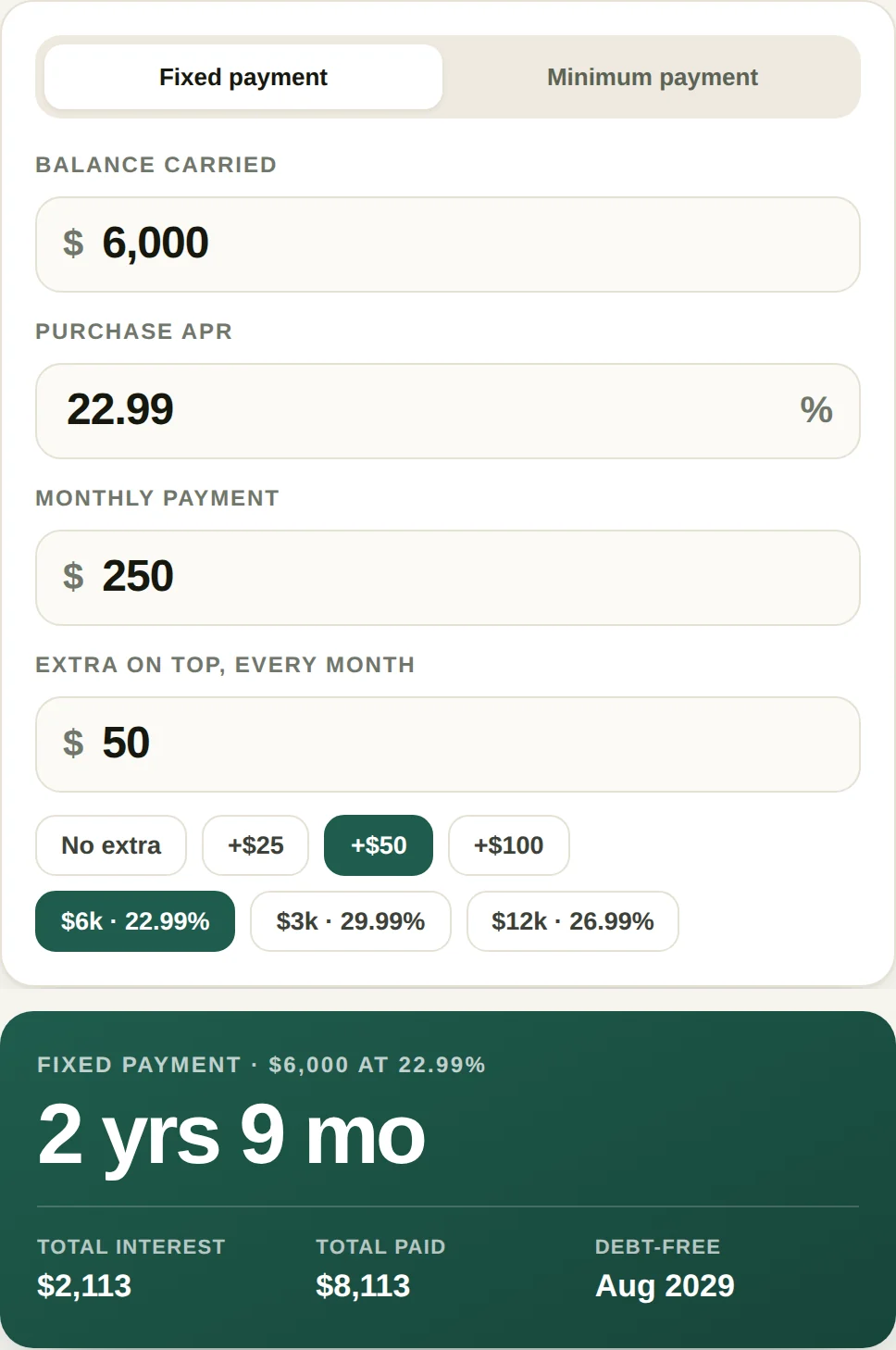
A balance, an APR and a monthly payment. The answer is a month you stop owing, the interest you pay to get there, and what one extra $50 does to both.
Issuers print either 2–3% of the statement balance or 1% of principal plus interest. Both are here: the percentage shrinks as the balance does, which is why the date moves so far out.
Horizontal axis: months from now. Vertical axis: balance still owed.
| Month | Payment | Interest | Principal | Balance left |
|---|
The last payment is usually smaller than the rest, because it only has to clear what is left.
- Interest modelBalance × APR ÷ 12
- New spending assumedNone
- Rate for the whole payoffFixed
Real cards compound daily on the average daily balance, so a statement charges about a dollar a month more on a $6,000 balance at 22.99% than the monthly model shows. That is why the month count tracks reality closely and the interest total lands a little low.
How the payoff arithmetic works
Interest is charged on the balance you carry, not on the payment you make, and the order of operations is fixed. Each month the interest is taken out of the payment first, and only what survives that goes to the principal. At 22.99% APR on $6,000 the monthly rate is 0.019158, so the first month's interest is $114.95. Pay $250 and $135.05 of principal disappears. Pay $114.95 and the balance is exactly where it started, a year from now and forever.
The calculator repeats that single step: multiply the balance by the monthly rate, subtract the payment, record the interest, stop when the balance reaches zero. Because the month count and the interest total come out of the same loop, they always agree with each other. A total interest figure that looks too small next to the month count is the usual sign of a calculator that mixed two different formulas.
One honest caveat. Cards compound daily at APR divided by 365 on the average daily balance, which for the same nominal rate works out about 0.9% more interest per month than APR divided by 12. On a $6,000 balance that is roughly a dollar a month, $116.00 against $114.95. Over a three-year payoff it is a few percent of the interest total, and it does not move the payoff month by more than one.
What the three numbers mean
- Months to clear. Full monthly payments until the balance is gone. The final payment is normally smaller, since it only has to cover what is left plus that month's interest. Thirty-three months means thirty-three statements, not thirty-three years.
- Total interest. Every interest charge added together. On $6,000 at 22.99% repaid at $250 it comes to $2,113, which is 35% of the original balance — the real price of borrowing, paid in instalments so small that nobody notices them.
- Total paid. Balance plus interest. If this number shocks you, the useful comparison is against the balance: the gap is what the delay costs.
- Debt-free month. Calendar arithmetic: today plus the number of payments, assuming the first one lands next month and every one after it is on time. One missed payment pushes the date out by a month and adds a late fee on top.
The comparison line under the result is the part worth acting on. It takes the payment you entered, adds the extra figure, and reports both the months saved and the interest saved. Those two numbers answer the only question most people actually have: is it worth finding another $50?
Why the minimum payment takes nineteen years
Card issuers compute the minimum in one of two ways: a percentage of the statement balance, usually between 2% and 3%, or 1% of the principal plus that month's interest. The second style sounds gentler and lands in the same place. At 22.99% on $6,000, 1% of principal is $60 and the month's interest is $114.95, so the minimum is $174.95 — 2.9% of the balance. Treating it as a 3% minimum is not an approximation, it is the same rule wearing a different label.
The problem is that the payment is a percentage of a shrinking number. At a 3% minimum with a $25 floor, $6,000 at 22.99% takes 235 months — nineteen and a half years — and costs $9,638 in interest, more than the balance itself. Drop the minimum to 2% and the payment falls almost as fast as the balance does: the first month's payment is $120 against $114.95 of interest, which retires $5.05 of principal. At that rate the balance halves roughly every 68 years. The model does not finish inside a century.
Nothing about this is a malfunction. It is what a percentage-based minimum does by construction, and it is why the same $6,000 costs $2,113 at a fixed $250 and $9,638 at the minimum. The gap between those two numbers is the single largest saving available in consumer finance, and it does not require a better rate or a new card.
A worked example: $6,000 at 22.99%
Five payment levels on the same balance, each run to zero. The extra column compares against $250.
| Monthly payment | Months | Total interest | Total paid | Against $250 |
|---|---|---|---|---|
| $200 | 46 | $3,012 | $9,012 | 13 months later, $899 more interest |
| $250 | 33 | $2,113 | $8,113 | — |
| $300 | 26 | $1,639 | $7,639 | 7 months sooner, $475 less |
| $350 | 21 | $1,343 | $7,343 | 12 months sooner, $770 less |
| $400 | 18 | $1,142 | $7,142 | 15 months sooner, $971 less |
Read the last column downwards and the shape is obvious. The first $50 above the minimum-sized payment buys 13 months and $899. The next $50 buys 7 months and $475. The fourth $50 buys 3 months and $201. Extra money is worth most early, when the balance is largest and every dollar of it is being charged interest, and it flattens out as the balance shrinks because there is less interest left to avoid.
That is also why a windfall belongs at the front of the schedule rather than spread out. Paying $1,200 as a lump sum in month one clears the debt in 25 months with $1,242 of interest. The same $1,200 arriving as $50 a month finishes in 26 months with $1,639 — $397 more for identical money, because the two years of extra payments spend most of their life earning nothing but a smaller interest charge. Front-loading the money also cuts the balance that the daily interest is calculated on, which is the only part of the arithmetic that compounds against you.
Where payoff estimates go wrong
- New spending. The model assumes nothing is added. Charge $300 a month on the same card and a $250 payment goes backwards — the balance rises every month no matter how disciplined the payment is. Paying a card down while still using it is the most common reason a payoff plan fails.
- A promotional rate that expires. A 0% window of 12 months followed by 27.99% is two different loans. The calculator takes one rate for the whole balance, so a payoff that straddles the end of a promo is optimistic by however much of the balance is still there when the rate jumps.
- Deferred interest. Store cards advertising "no interest if paid in full in 18 months" back-charge the entire period if you miss by a day. On a $3,000 purchase at 29.99%, 18 months of retroactive interest is about $1,350 arriving as a single line on one statement.
- Late fees and the penalty rate. A $39 late fee is the smaller problem; the penalty APR that follows, commonly 29.99%, raises the monthly interest on $6,000 from $114.95 to $150 and the fee itself starts accruing interest immediately.
- Balance transfer fees. A 3% fee on $6,000 is $180 charged on day one, before any interest is saved. A 0% window of 12 to 21 months is also shorter than the 33-month payoff in the example, so the calculation only works if the balance clears inside the window.
- Payment timing. Interest accrues on the average daily balance, so the due date matters. Paying on day 25 rather than day 3 of a cycle adds about 22 days of interest on the payment amount: $2.50 on a $180 payment, $25 on $1,800.
- Several cards, one payment. The model handles one balance. With three cards, splitting a fixed payment evenly is the expensive choice — every dollar sent to the 15% card instead of the 29% card costs about 1.2¢ a month, and that compounds for as long as both balances exist. The loan calculator and the mortgage calculator use the same amortisation loop for fixed-rate debt, where the rate cannot move under you.
Questions
Why is the payoff date different from my statement's estimate?
Statements usually print an estimate based on the minimum payment only, and many print it assuming no further purchases. This page uses the payment you enter and a fixed rate for the whole life of the balance. Both are estimates; the statement's is the more pessimistic of the two because a percentage minimum shrinks as the balance falls.
Does the calculator really charge APR divided by 12?
Yes, and that slightly understates the interest. Cards compound daily at APR divided by 365 on the average daily balance, which works out about 0.9% higher per month than APR divided by 12. On a $6,000 balance at 22.99% that is roughly a dollar a month, so the payoff month is right and the interest total runs a few percent light.
What payment counts as the minimum?
Issuers use either a percentage of the statement balance, usually 2% to 3%, or 1% of the principal plus that month's interest. The second style is not gentler: at 22.99% on $6,000, 1% of principal plus $114.95 of interest is $174.95, which is 2.9% of the balance. Enter whichever figure your statement prints and the two styles converge.
Should I pay off the highest APR first or the smallest balance?
Highest APR first costs less in total, always. Smallest balance first clears one account sooner, which some people need in order to keep going. The difference on two cards a few points apart is usually small; the difference between either method and paying the minimum on both is enormous.
Does a 0% balance transfer beat paying this card down?
Sometimes, but subtract the fee first. A 3% transfer fee on $6,000 is $180, and the 0% window is usually 12 to 21 months while the payoff at $250 a month takes 33. Whatever is left when the window closes is charged at the card's standard rate, often above 27%, so a transfer only wins if the balance clears inside the promotional period or the remaining balance is small.
Related calculators
Free, and it stays free
Payoff arithmetic is a loop, not a service. No login, no counter, no limit on how many balances you run.
- Every balance, rate and payment — unlimited
- Nothing you type leaves this tab