Mortgage calculator — what the house actually costs.
Payment, interest and payoff date — including what one extra payment a month would do.
Set this to 0 to see the plain schedule. Anything above 0 goes straight to principal.
- Total interest—
- Total of payments—
- Payoff date—
- Interest as share of loan—
- Saving from extra payment—
Building a mortgage payment from the house price up
The number a lender quotes is not just principal and interest. It is usually PITI — principal, interest, taxes and insurance — and leaving out the last two is how people end up with a payment they did not budget for.
- Enter the home price and your down payment. The down payment can be entered as a percentage or a dollar amount. 20% avoids private mortgage insurance in the US; below that, PMI is normally added until the loan balance falls under 80% of the original value.
- Enter the interest rate and term. Thirty years is the US default, fifteen is the common shorter option. A 15-year loan carries a lower rate and a much higher payment, and saves a large amount of interest.
- Add property tax and insurance. Both are annual figures, and both are usually collected monthly into an escrow account. If you do not know them, the local assessor’s website has the tax rate and an insurance quote takes ten minutes. Guessing is fine for planning as long as you mark the number as a guess.
- Try the extra payment field. This is the part most calculators leave out. Adding a modest amount to every payment shortens the term and cuts the interest substantially, because the extra goes entirely to principal.
When this comes up
- Working out what you can actually afford. Affordability is the PITI number, not the principal-and-interest number. On a $400,000 loan at 6.5%, taxes and insurance can easily add 25–30% on top of the base payment.
- Deciding between 15 and 30 years. The 15-year payment is roughly 45% higher, and the interest saved is usually six figures. Whether that trade is worth it depends on whether the higher payment leaves you with an emergency fund.
- Checking whether to refinance. Enter the current loan at the new rate and compare payments. The monthly saving is the number to weigh against closing costs, and the break-even month is where the two lines cross.
- Seeing what one extra payment a year does. A single extra payment annually is a common habit and produces a measurable result over thirty years. The extra-payment field shows it directly.
A worked example: $400,000 house, 20% down, 30 years at 6.5%
20% down is $80,000, leaving a loan of $320,000. Principal and interest come to $2,022.62 a month. Add $4,800 of property tax and $1,800 of insurance, each divided by twelve, and the real monthly cost is $2,572.62.
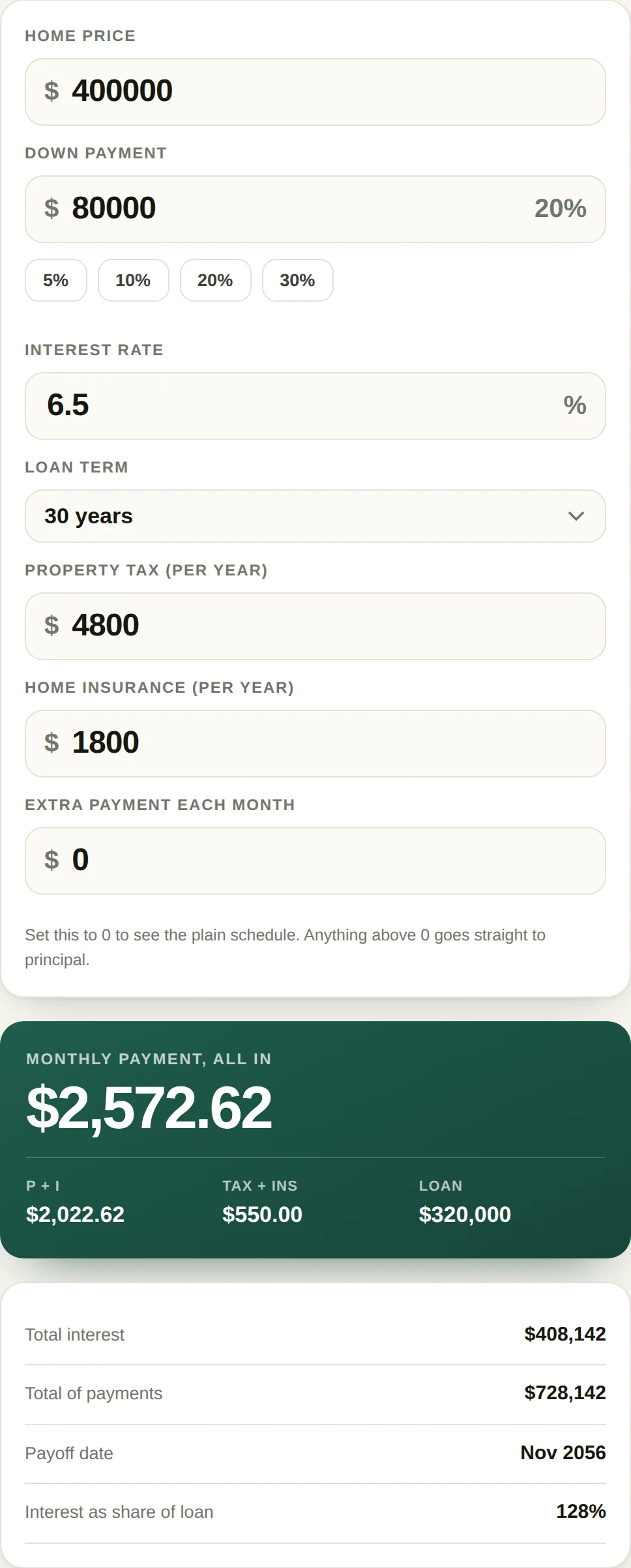
That $550 gap between the mortgage payment and the actual cost is where first-time budgets break. Tax and insurance are not optional extras bolted on at the end; they are escrowed and collected monthly, and they rise. Insurance in particular has been repricing quickly in fire- and flood-exposed areas, and the shortfall arrives as a letter rather than a warning.
| Scenario | Loan | Principal + interest | Change |
|---|---|---|---|
| 20% down, 6.5% | $320,000 | $2,022.62 | — |
| 20% down, 7.5% | $320,000 | $2,237.49 | +$214.87 |
| 10% down, 6.5% | $360,000 | $2,275.44 | +$252.82 |
One point of rate costs about $215 a month on this loan, which is roughly $77,000 across thirty years. Halving the down payment costs $253 a month and adds mortgage insurance on top — which is why the 20% threshold is worth chasing even when it delays the purchase by a year.
Extra payments are the reverse lever. Anything above the scheduled amount goes to principal and removes the most expensive months at the far end of the loan, so $200 extra now is worth considerably more than $200 saved later. The tool leaves the monthly figure unchanged and shows the effect on the payoff date instead.
Where mortgage maths goes wrong
- Forgetting the other three numbers: HOA dues, maintenance (budget about 1% of value a year) and closing costs (2–5% of the price, paid in cash on the day).
- Assuming the tax assessment equals the purchase price. It often does not, and the first post-sale reassessment moves the escrow payment months later.
- Comparing 30-year and 15-year payments without comparing total interest. A 15-year loan costs roughly 38% more a month and about 55% less interest.
- Treating the rate as the only negotiable. Points, lender credits and fees all move the effective cost, and the lowest headline rate is frequently the most expensive loan.
Questions
What does PITI stand for?
Principal, Interest, Taxes and Insurance. It is the full monthly housing cost a lender actually underwrites, and it is the number to use when deciding whether a house is affordable. Some loans add HOA dues or mortgage insurance on top, which is why the total can be higher than any single online estimate.
How much difference does a 20% down payment make?
Two things. It removes private mortgage insurance, which typically costs 0.3–1.5% of the loan amount per year, and it lowers the loan balance so less interest accrues. On a $400,000 house, going from 10% to 20% down can reduce the monthly payment by several hundred dollars for both reasons combined.
Why does paying $200 extra a month save so much?
Because interest is charged on the outstanding balance, and an extra payment removes principal permanently. Every dollar of principal removed stops generating interest for the remaining life of the loan — on a 30-year loan that is a long time for compounding to work in your favour instead of the bank’s.
Does a longer term ever make sense?
Yes, in two situations: when the lower payment is the only way to keep the house, and when the money you are not putting into the mortgage is being invested at a higher return than the mortgage rate. The second case is real but requires discipline, because the payment difference tends to get spent rather than invested.
More money tools
All-Access — every tool, one payment
The calculator is free and stays free. All-Access removes the upgrade prompt and unlocks every tool on this site.
- Every current tool, fully unlocked
- Every tool added later, included free
- No ads, no signup, no subscription