Retirement calculator — will it be enough?
What your savings turn into, what that buys in today's money, and what you could draw.
A global index fund has historically returned about 7% a year before inflation. Long-run inflation runs near 3%.
- Years of growth—
- Monthly draw at 4% a year—
- Same draw in today's money—
- Years of contributions—
- So each $1 you add becomes—
The 4% rule is a rough planning shortcut: draw about 4% of the balance in year one, then raise it with inflation. It is not a guarantee.
Are you on track, and what would change it
Retirement arithmetic has one output people want — the balance at the end — and one they need — what that balance is worth in today’s money. This calculator gives both, because a number thirty years out means nothing without the second.
- Enter your age and planned retirement age. The gap between them is the accumulation window. Moving retirement two years later helps twice: two more years of contributions, and two fewer years the money has to last.
- Enter current savings and monthly contributions. Include employer matches, since that is real money going in. If you are not sure of your balance, an estimate within 10% is close enough for a planning tool.
- Set an expected return and an inflation rate. The default pair is deliberately conservative. A high return with low inflation produces a projection that is arithmetically correct and practically useless.
- Read the real number. The "today’s money" figure discounts the future balance by inflation. That is the number to compare against your current annual spending, because it describes a lifestyle you can actually picture.
When this comes up
- Checking whether your current contribution is enough. This is the most common reason to open a calculator like this, and the answer is usually more useful as a range than a single figure.
- Deciding between retiring at 62 and 67. The difference in the final balance is large, and the difference in how long the money has to last is larger still. Both halves of the trade-off matter.
- Working out what a raise should go to. If you increase contributions by the amount of a raise, the lifestyle change is zero and the retirement number moves noticeably. The tool shows how much.
- Comparing a pension offer with a defined-contribution pot. Convert the pension to an equivalent balance and compare like with like, rather than comparing a monthly promise against a lump sum.
A worked example: 30 today, retiring at 65, $40,000 saved
At $500 a month and a 6% return, the pot reaches $1.04 million by 65. In today's money, at 2.5% inflation, that is $437,000. You will have paid in $250,000 — the $40,000 you already have plus 420 monthly contributions.
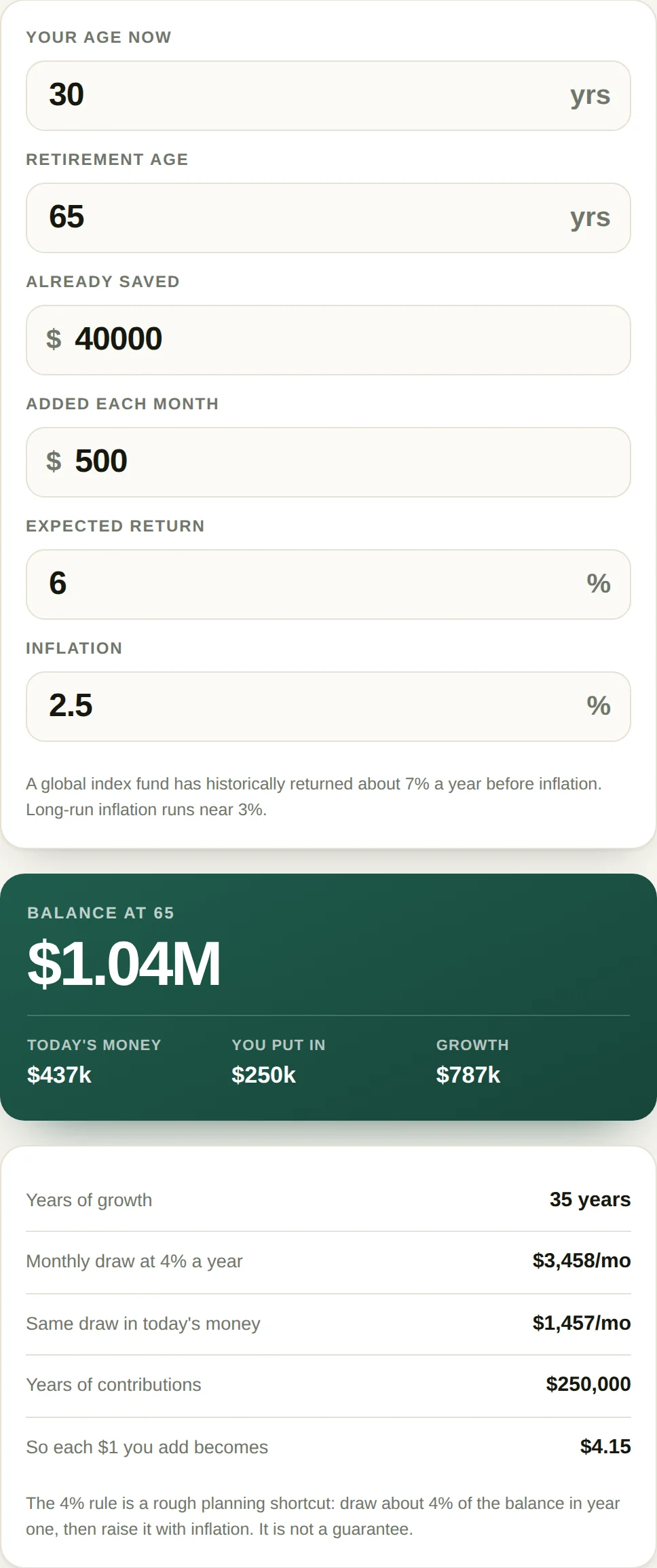
Those two figures on screen are the entire argument for modelling inflation at all. $1.04 million sounds like a comfortable retirement; $437,000 in today's prices is a modest one. Neither is wrong — they answer different questions. Use the nominal number when comparing against a projection that ignores inflation, and the real number when deciding whether the contribution is enough.
Against the 4% rule, $437,000 of real money supports roughly $17,500 a year of spending in today's terms, before any state pension. If that falls short, the fix is almost always the contribution rather than the return: raising $500 to $700 a month adds about $285,000 nominal by 65, while hoping for 8% instead of 6% adds risk as much as money.
Where retirement projections go wrong
- One average return, no sequence. A crash in the five years before retirement does far more damage than the same crash at 35, and a single 6% line cannot show it.
- The 4% rule is a rule of thumb from a different era — US data, 30-year horizons, a specific mix of shares and bonds. A sanity check, not a plan.
- Contribution growth is ignored. Most people raise savings with pay rises; holding the amount flat makes this projection pessimistic in a useful way.
- Healthcare and long-term care are the two costs that routinely exceed the model, and neither appears in a balance projection.
Questions
What is the 4% rule?
A rough guideline from the 1990s saying that withdrawing 4% of a portfolio in the first year, then adjusting that dollar amount for inflation, historically lasted at least thirty years in most US market periods. It is a planning heuristic, not a guarantee, and it was derived from US data in a particular century.
Why do you show a number in today’s money?
Because $1.2 million in thirty years is not $1.2 million of lifestyle. At 3% inflation, thirty years erodes purchasing power by about 60%. Showing both numbers stops the common mistake of projecting a big figure and assuming it buys what it would buy today.
What return should I assume?
For a diversified portfolio over a multi-decade horizon, something in the 5–7% range after inflation is a common planning assumption, and 7% before inflation is the figure most US illustrations use. Anyone quoting 10% or more as a safe assumption is extrapolating from a good decade.
Does this account for Social Security or a state pension?
No. It projects your savings only. If you will also receive a pension, subtract the expected annual pension from your target spending before deciding whether the projected balance is enough — or use the balance here as the part you have to fund yourself.
More money tools
All-Access — every tool, one payment
The calculator is free and stays free. All-Access removes the upgrade prompt and unlocks every tool on this site.
- Every current tool, fully unlocked
- Every tool added later, included free
- No ads, no signup, no subscription