Calorie calculator — how much should you eat?
Your daily burn, a target for your goal, and the protein that goes with it.
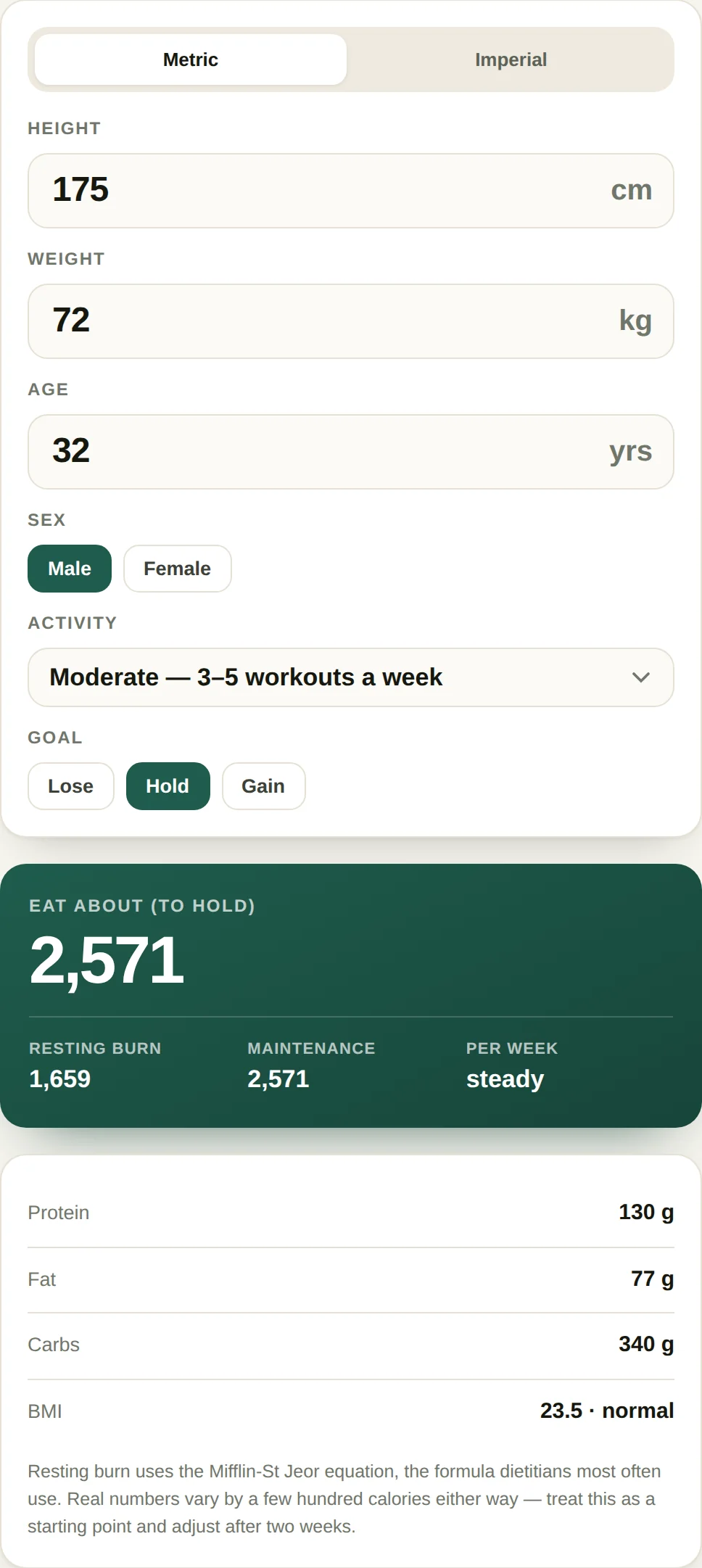
- Protein—
- Fat—
- Carbs—
- BMI—
Resting burn uses the Mifflin-St Jeor equation, the formula dietitians most often use. Real numbers vary by a few hundred calories either way — treat this as a starting point and adjust after two weeks.
Working out daily calories from your own numbers
Calorie needs come from four inputs — sex, age, height, weight — plus how much you move. This tool uses the Mifflin-St Jeor equation, which is the one most dietitians consider the most accurate of the simple formulas.
- Enter sex, age, height and weight. All four are needed because basal metabolic rate depends on all of them. The unit toggle switches between metric and imperial and converts the values already entered.
- Pick an activity level. This is where most estimates go wrong. "Moderately active" means exercising three to five times a week, not walking to the station. Most people who work a desk job and exercise twice a week are in the light category.
- Read the maintenance figure. That is the calories needed to stay at the current weight. Everything else is derived from it.
- Choose a goal. A deficit produces loss, a surplus produces gain. The tool shows the rate those numbers imply, because a 500-calorie daily deficit is roughly half a kilogram a week and a 1,000-calorie deficit is not twice as sustainable.
When this comes up
- Starting a weight change and needing a number to aim at. A target range is more useful than a single figure and considerably more useful than a guess.
- Checking whether a diet app’s target is plausible. Apps sometimes set targets below basal metabolic rate, which is neither sustainable nor medically sensible. Reconstructing the maintenance figure shows whether the target is reasonable.
- Understanding why weight has drifted. If intake has crept up by 200 calories a day, the arithmetic explains a slow gain that otherwise looks mysterious.
- Planning meals for training. Knowing maintenance makes it possible to decide whether to eat at, below, or above it on a given day rather than guessing.
A worked example: 175 cm, 72 kg, 32 years old
Resting burn comes out at 1,659 kcal. That is the Mifflin–St Jeor equation for men: 10 × weight + 6.25 × height − 5 × age + 5. Apply the "light exercise, 1–3 days a week" multiplier of 1.375 and maintenance lands at about 2,281 kcal a day.
Almost every disappointing diet starts with that multiplier. "Moderately active" means three to five days of exercise a week, and it assumes the rest of the day is not spent sitting down. Someone in a desk job who trains four times a week is usually nearer 1.375 than 1.55, and the 250-calorie difference is roughly half a pound a week — enough to explain a plateau that feels like a mystery.
The other thing to expect is drift. A 72 kg body at 2,281 kcal becomes a 68 kg body at about 2,226, so the deficit that shifted the first five kilos produces nothing by the tenth. Recalculate every 4–5 kg, or the plan quietly stops being a deficit.
Where calorie maths goes wrong
- Eating back exercise calories. Trackers and gym machines overstate burn, often by 30% or more, and the appetite after cardio generally exceeds the burn.
- Under-reporting intake. Studies consistently find people underestimate what they eat by 20–30%, mostly through oils, drinks and tastes while cooking.
- Weekly averages beat daily ones. A 300-calorie daily deficit and a 2,100-calorie weekly one are the same thing; the second is far easier to live with.
- Water weight hides progress. Glycogen holds about 3 g of water per gram, so a low-carb week can show 2 kg lost that is not fat, and a single refeed can put it back in a day.
Questions
How accurate is this?
The Mifflin-St Jeor equation is typically within 10% for most adults, which on a 2,400-calorie maintenance figure is a range of about 240 calories. That is close enough to plan with and not close enough to treat as exact. Use the number for two weeks, compare it with what actually happens to your weight, and adjust.
Why does activity level change the answer so much?
Because movement is the largest variable in the equation. The difference between sedentary and very active can be 700 calories a day at the same body size, which is more than most people realise. This is also the field people most often overestimate about themselves.
Is a 1,200-calorie diet safe?
For most adults it is below basal metabolic rate and is not a level to stay at without medical supervision. Very low intakes tend to produce muscle loss alongside fat loss and are hard to sustain, which is why they usually end in regain. A moderate deficit is slower and more durable.
Do I need to count calories forever?
No. Counting is a calibration exercise: it teaches you what portions actually contain. Most people can stop after a few months and maintain by adjusting based on the scale, which is the same feedback loop in a cheaper form.
More everyday tools
All-Access — every tool, one payment
The calculator is free and stays free. All-Access removes the upgrade prompt and unlocks every tool on this site.
- Every current tool, fully unlocked
- Every tool added later, included free
- No ads, no signup, no subscription