Debt snowball — four debts, one extra payment, and the order that clears them.
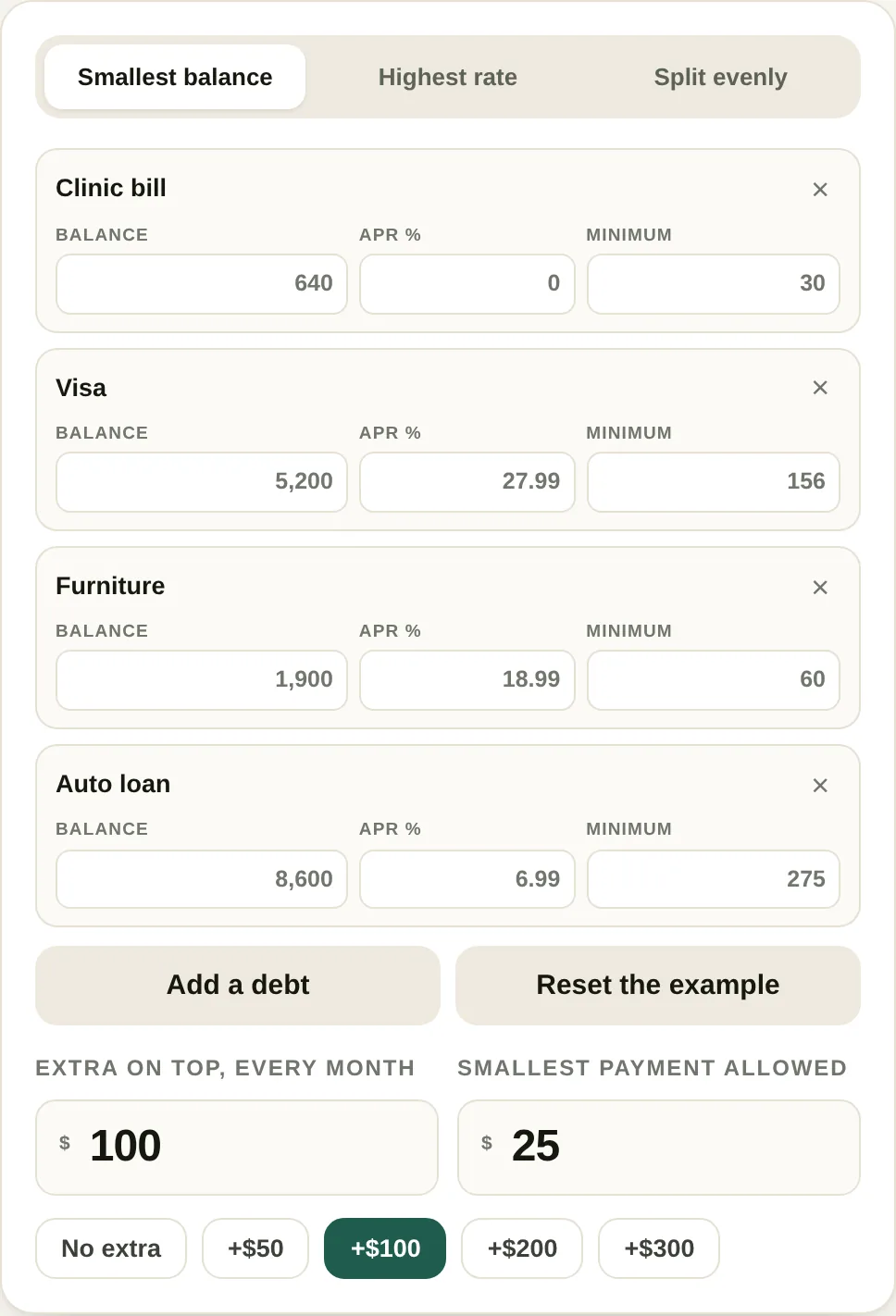
Every balance, rate and minimum on one screen. The spare cash rolls from the debt you finish to the next one, and you see the month each account closes and the interest that was paid to get there.
Horizontal axis: months from now. Vertical axis: total balance still owed.
The order, and when each account closes
Every payment above the minimum goes to the top debt until it is gone, then the whole payment moves down one place.
Same debts, three orders
| Order | Months | Interest | Total paid | Against the cheapest |
|---|
| Month | Paid | Interest | Principal | Balance left |
|---|
Interest is charged on every open balance before any payment is applied, which is why the first month costs the most.
- Interest modelBalance × APR ÷ 12
- New borrowingNone on any account
- Rates over the planFixed
- Missed paymentsNone
Real cards compound daily on the average daily balance, roughly 0.9% more per month than APR divided by 12, so the interest totals here run a few percent light. The month each account closes is unaffected unless a rate changes.
How the rollover works, month by month
Each month three things happen in a fixed order, and every debt calculator that gets the same answer does them the same way. Interest is added to every open balance first. The minimum is then taken from every open account. Whatever is left of your payment — the extra plus any minimum you no longer owe because an account closed — goes to one debt only: the top one in the order.
The four debts used in the example add up to $16,340 with minimums of $521 a month: a $640 clinic bill at 0%, a $5,200 card at 27.99%, $1,900 of furniture at 18.99% and an $8,600 auto loan at 6.99%. In month one the interest charge across all four is $201.45. You pay $521 of minimums plus $100 of extra, so $621 leaves the account and $419.55 of it is principal. Run that same step sixty-six times, rolling each freed minimum down the list, and the debt is gone.
The part people underestimate is the rollover. The clinic bill clears in month 5 under the balance order, and its $30 minimum does not vanish — it becomes part of the attack on the furniture. By the time the card is the only thing left, the payment pointed at it is the original $521 plus $100, because every other minimum has been freed. That accelerating payment, not the ordering, is what turns a six-year schedule into a four-year one. Run the loop forty-eight times and the debt is gone; leave the payment at the $521 of minimums alone and the same four debts take sixty-six months and $6,617 of interest.
What the three result numbers mean
- Months. Statements until the last balance reaches zero, with the final payment usually smaller because it only has to clear what is left. Forty-eight months is forty-eight statements, four years of the same transfer on the same day.
- Total interest. Every interest charge added together. On the four debts above at $100 extra it is $5,203 — about a third of the original balance, paid in monthly instalments small enough that nobody notices them leaving.
- Total paid. Principal plus interest, $21,543 in the same run. The gap against $16,340 is the price of the delay, and it is the only number that changes when you move the extra payment up or down.
- First debt gone. The month the first account closes. It is the number the snowball method is built around, and the one that differs most between the two orders: month 5 for balance order, month 22 for rate order on these four debts.
Snowball against avalanche on the same four debts
Both orders use identical money and identical minimums; only the destination of the extra changes. Six extra-payment levels, each run to zero:
| Extra each month | Snowball: months | Snowball: interest | Avalanche: months | Avalanche: interest | Gap |
|---|---|---|---|---|---|
| $0 | 66 | $6,617 | 64 | $6,488 | 2 months, $129 |
| $50 | 55 | $5,844 | 42 | $4,390 | 13 months, $1,454 |
| $100 | 48 | $5,203 | 35 | $3,522 | 13 months, $1,681 |
| $150 | 34 | $3,820 | 32 | $2,999 | 2 months, $821 |
| $200 | 31 | $3,311 | 30 | $2,620 | 1 month, $691 |
| $300 | 27 | $2,650 | 26 | $2,128 | 1 month, $522 |
Read the gap column and the shape is odd at first: the two orders are almost identical at $0 and almost identical at $300, and $1,681 apart in the middle. At no extra payment every debt is on its own minimum and the order barely matters. At $300 a month the whole plan is short enough that the 27.99% card is cleared before its rate can do much damage either way. The expensive middle is where a plan usually lives, and it is exactly where the choice of order costs the most.
So the honest summary is that avalanche is cheaper, by $1,681 here, and snowball buys the first closed account 17 months earlier. Whether that trade is worth $1,681 depends on whether you have abandoned a payoff plan before. The tool exists so the trade can be seen as a number instead of an argument.
A worked example, with the interest split out
Same four debts, $100 extra, snowball order. What each account actually cost before it closed:
| Debt | Balance | Rate | Closes in month | Interest paid | Total paid |
|---|---|---|---|---|---|
| Clinic bill | $640 | 0% | 5 | $0 | $640 |
| Furniture | $1,900 | 18.99% | 17 | $329 | $2,229 |
| Auto loan | $8,600 | 6.99% | 30 | $854 | $9,454 |
| Visa | $5,200 | 27.99% | 48 | $4,020 | $9,220 |
The card pays $4,020 of interest because it sits last and carries its balance for four years. Under the rate order the same card closes in month 28 with $1,926 of interest, and the furniture moves from month 17 to month 34, picking up $675 instead of $329. That is the whole trade in two rows: $2,094 saved on the card against $413 more on the furniture and the auto loan, and the clinic bill left alone on its $30 minimum for 17 extra months.
Now the third option, which neither camp talks about. Split the $100 evenly across all four accounts every month and the plan finishes in 41 months with $4,461 — better than snowball's 48 and $5,203, worse than avalanche's 35 and $3,522. It beats snowball because part of every month's extra reaches the 27.99% card immediately rather than waiting for a 0% bill to close first. It loses to avalanche because three-quarters of the extra is still being spread across cheaper debt.
Where payoff plans break
- A minimum below the interest. The most common silent failure. A $5,200 card at 27.99% is charged $121.29 in month one; a $100 minimum leaves the balance $21.29 higher and every month after it worse. The page reports this as never clearing rather than printing a date, because no order of debts rescues a payment that does not cover the interest.
- Spending on a card that is in the plan. Charge $200 a month on the card you are paying down and the schedule is fiction: the balance falls $100 instead of $300, and the payoff month moves out by more than a year on a four-year plan. Either the card stays out of the wallet or it comes out of the calculation.
- A promotional rate expiring mid-plan. A 0% window that ends in month 15 turns the largest balance into the most expensive one on the list overnight, which flips the correct order. Re-run the numbers at the month the promo ends rather than at the rate printed today.
- The freed minimum absorbed into spending. The rollover is what shortens the plan. If the $30 from the closed clinic bill goes to groceries instead of the furniture, the schedule stretches by years and the interest total goes back up toward the minimum-only figure of $6,617.
- Forgetting the tax and the escrow. A student loan payment may be partly deductible and a car loan payment may include escrow or insurance, neither of which reduces the balance. Enter only the part of the payment that touches principal plus interest, or the schedule clears the debt earlier than it will.
- One missed payment. A late fee of $39 is the small cost; the penalty rate that follows, often 29.99%, is charged on the whole balance and pushes the payoff month out. On the $5,200 card that is another $8 a month of interest for as long as the penalty rate holds.
- Settling a debt instead of paying it. A settled account reports as settled for less than owed, which is a negative mark that outlasts the payoff. If a settlement is on the table, the arithmetic changes entirely and belongs in a different conversation from this one.
The single-debt case is the credit card payoff calculator, which shows one balance and one payment without any ordering. Fixed-rate instalment debt amortises the same way in the loan calculator, and if the question is what the money would do left alone, the compound interest calculator runs the same loop in the other direction. For a payment that is a share of income rather than a fixed figure, the salary calculator is the quicker route to a monthly number.
Filling in the four fields honestly
Balance: the statement balance, not the original loan amount and not a figure from three months ago. Rate: the purchase APR printed on the statement, which is often higher than the headline rate you signed up for. Minimum: the exact figure the issuer will take, because a percentage minimum shrinks as the balance does and the floor is what actually applies at the end. Extra: money that already exists in the month, not money that would come from the card being paid down.
Two sanity checks before trusting the output. The first month's interest should look plausible against the first month's payment — if interest is more than half the payment, the plan is mostly servicing debt and the extra payment is doing all the work. And the total interest should be smaller than the total balance; if it is larger, the minimums are too low relative to the rates and the order of the debts is not the problem.
Questions
Is the snowball or the avalanche cheaper?
Avalanche, always, because it sends every spare dollar to the highest rate. On four debts of $16,340 with $100 extra a month, avalanche finishes in 35 months with $3,522 of interest and snowball in 48 months with $5,203 — $1,681 more. Snowball buys an earlier first win instead: its smallest debt clears in month 5 rather than month 22.
How do freed-up minimum payments get handled?
The moment a debt clears, its minimum joins the extra payment and goes to the next debt in the order. That rollover is the whole mechanism. If you absorb the freed $30 into spending instead, the plan reverts to paying minimums and the payoff date moves out by years.
Should I use the statement balance or the payoff amount?
The statement balance, which includes this month's interest and any pending charges. The payoff amount on a card is usually a few dollars higher because it adds interest accrued since the statement closed; that difference is too small to change the order, but a stale balance is not — a figure two months out of date understates the interest by roughly 4% on a 24% card.
What if my minimum payment is lower than the monthly interest?
Then the balance grows every month and no ordering fixes it. A $5,200 card at 27.99% is charged $121.29 in the first month; a $100 minimum leaves the balance $21.29 higher than it started. The tool reports this as never clearing rather than printing an optimistic date. The payment has to exceed the month-one interest before the order of debts matters at all.
Does an extra payment belong on the debt or in savings?
Compare the rate with what the cash would earn after tax. Paying a 27.99% card is a guaranteed 27.99% return; a savings account paying 4% is not close. The exception is a thin emergency fund — paying every spare dollar to a card and then charging the next repair back at 27.99% undoes the progress and adds a month.
Can I include a mortgage or student loan here?
Yes, as long as the payment is fixed and there is no new borrowing on the account. A mortgage on a 30-year schedule usually outlives every other debt in the list, so it clears last and the result reads sensibly. Revolving credit lines are the awkward case: charging new purchases to a card that is part of the plan resets its balance and invalidates the schedule.
Related calculators
Free, and it stays free
Payoff ordering is a loop, not a service. No login, no counter, no limit on how many debts you enter.
- Up to twelve accounts, any mix of rates
- Nothing you type leaves this tab