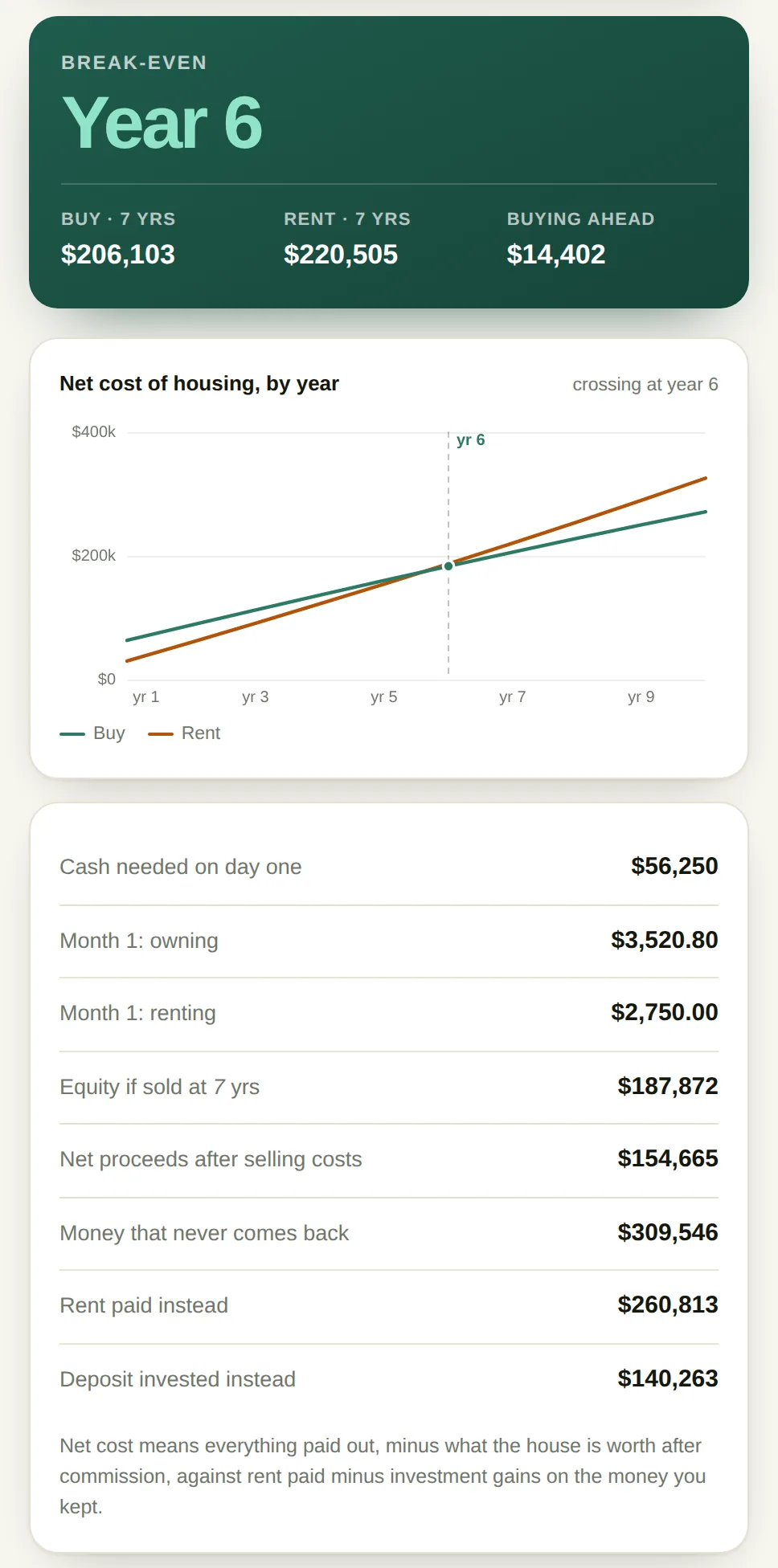
Rent vs buy — where the two lines cross.
Every cost of owning against the rent you would pay instead, including the return you give up on the deposit.
Insurance is inflated at 2.5% a year. Everything else follows the rates above, compounded monthly.
- Cash needed on day one—
- Month 1: owning—
- Month 1: renting—
- Equity if sold at 7 yrs—
- Net proceeds after selling costs—
- Money that never comes back—
- Rent paid instead—
- Deposit invested instead—
Net cost means everything paid out, minus what the house is worth after commission, against rent paid minus investment gains on the money you kept.
What the break-even year actually measures
The break-even year is the first year in which selling the house leaves you with more money than never buying it would have. It is not the year the mortgage is paid off, and it is not the year your equity passes some round number. It is the year one household's balance sheet overtakes the other's, with the house sold and the loan cleared.
Both sides are built the same way: total out, minus what comes back. The buying line adds the deposit, the closing costs, every mortgage payment, property tax, insurance, maintenance and HOA dues, then subtracts the sale price net of commission and the outstanding loan. The renting line adds the rent paid and subtracts the investment gains on the money that was never tied up — the deposit, and the monthly difference between owning and renting. Whichever line is lower at year N is the cheaper way to have housed yourself for N years.
That structure is why the answer is not obvious from the two monthly payments. A mortgage payment is mostly interest at the start and mostly principal at the end, while rent is pure spending from the first month to the last. The payments can look similar for a decade while the two balance sheets move in opposite directions.
Reading the numbers off the screen
- The big figure is the break-even year. It appears green when owning gets there inside thirty years, and reads "30+ yrs" when it never does. Above thirty years the model stops, because a thirty-year projection of rent growth is fiction rather than forecasting.
- Ahead, at your horizon. The three figures under the headline compare net cost at the number of years you selected, not at break-even. Staying seven years and buying when the break-even is nine is a losing trade even though the headline says six.
- Money that never comes back. Interest, property tax, insurance, upkeep, HOA dues, closing costs and the commission on the sale. This is the number to compare directly against rent paid, because neither comes back.
- Deposit invested instead. What the renter's portfolio is worth at the horizon after the monthly savings are added to it and returns are compounded monthly. When the rent overtakes the fixed mortgage payment, the flow reverses and the portfolio starts funding the gap.
A worked example: $450,000 with 10% down, against $2,750 rent
Ten percent down is $45,000, and 2.5% closing costs add $11,250, so the buyer needs $56,250 in cash on day one. The loan is $405,000 at 6.4% over thirty years: $2,533.30 a month of principal and interest, of which only $373.30 touches the balance in month one. The other $2,160.00 is interest.
Add property tax at 1.1% of value ($412.50 a month), insurance at $2,400 a year ($200), and upkeep at 1% of value ($375), and the first month of owning costs $3,520.80 against $2,750 of rent. The buyer is $770.80 a month worse off in cash and $56,250 worse off on the day of completion.
Owning still wins, in year six. Equity reaches $164,986 by then, and after a 6% commission the cheque at closing is $132,746. Rent for the same six years comes to $219,601 against a net cost of owning of $183,369 — a difference of $3,761, and that is the whole margin at the crossing point. Move out a year earlier and the renter is $5,697 ahead instead.
| Years held | Buying, net cost | Renting, net cost | Cheaper by |
|---|---|---|---|
| 3 | $112,527 | $91,101 | Rent, $21,426 |
| 5 | $160,177 | $154,480 | Rent, $5,697 |
| 6 | $183,369 | $187,130 | Buy, $3,761 |
| 7 | $206,103 | $220,505 | Buy, $14,402 |
| 10 | $271,257 | $325,692 | Buy, $54,435 |
| 15 | $367,572 | $523,058 | Buy, $155,486 |
The buying line flattens because the mortgage payment is fixed while the loan shrinks and the house grows; the renting line steepens because rent compounds at 3.5% and, from about year ten, overtakes the monthly cost of owning. That is the whole mechanism. Nothing about owning gets cheaper — the payment simply stops rising.
Why the answer moves so much
Each row below is the same house with one assumption changed, recomputed by the tool. The spread from year four to year twelve is the honest range of this decision: a difference in rate or rent of a few hundred dollars is worth more than years of debate.
| One change from the example | Break-even |
|---|---|
| Mortgage rate 6.4% → 7.4% | year 10 |
| Mortgage rate 6.4% → 5.4% | year 4 |
| House growth 3% → 2% | year 10 |
| House growth 3% → 4% | year 4 |
| Rent $2,750 → $2,400 | year 12 |
| Rent $2,750 → $3,000 | year 4 |
| Selling costs 6% → 8% | year 7 |
| Investment return 6% → 8% | year 8 |
| Upkeep 1% → 1.5% of value | year 8 |
Two of those rows deserve attention. A single point of mortgage rate is worth four years of break-even here, because the rate multiplies a $405,000 balance. And a 20% lower rent moves the answer six years later without touching the house at all — which is why the same property can be a good buy for one person and a bad one for another, purely on what the rental alternative costs them.
Where rent-versus-buy maths goes wrong
- Comparing the mortgage payment with the rent. Tax, insurance, upkeep and HOA add 39% to the $2,533.30 payment in the example. Anyone quoting only principal and interest is quoting a number nobody pays.
- Treating the deposit as a cost. It is a transfer, and it comes back inside the sale cheque. Counting it as spent money inflates the buying side by $45,000 and makes buying look hopeless. Counting it as free ignores the $2,700 a year it would have earned at 6%.
- Forgetting the commission. Six percent of the sale price is 18 months of appreciation at 3%. Sell in year three and the commission alone can exceed every gain the house made.
- Assuming upkeep is a rounding error. One percent of value is the rule of thumb, and it arrives unevenly: a $9,000 roof in year seven, nothing in years two to six. Averages hide the cash-flow shock.
- Holding today's rent constant. Rent has been growing about 3.5% a year over the long run. Freezing it at today's figure is the single most common way a rent-versus-buy spreadsheet flatters renting.
- Comparing a thirty-year answer with a five-year life. The break-even is a holding-period calculation. If you move in four years, the only number that matters is the three-to-five-year row.
- Ignoring that rent is a ceiling and a mortgage payment is a floor. The rent is the most you pay; the mortgage is the least, with tax, insurance and repairs on top, and insurance has been repricing sharply in fire- and flood-exposed areas.
Questions
What counts as a good break-even year?
Under five years is comfortable: you keep a margin if you move sooner than planned. Five to eight years is the normal range for a house bought with 10–20% down at mortgage rates around 6%, held long enough for a fixed payment to fall behind rising rent. Past ten years, renting usually wins unless the rent on an equivalent house is within about 20% of the all-in cost of owning, which happens in metros where price-to-rent ratios run above 25.
Why does a bigger deposit barely move the break-even year?
Because it scales both columns. More down means a smaller loan and less interest, but also more capital that could have been earning a return somewhere else. At 10% and 20% down on the example above, the break-even lands in the same year, while the month-one payment falls by about $280 and the cash needed on the day of purchase rises by $45,000. The deposit changes what you can afford and how much risk you carry, not which option is cheaper.
Does this include the mortgage interest tax deduction?
No, and for most buyers in the United States that omission is closer to correct than it used to be. The standard deduction absorbs the interest on a loan of this size for a married couple filing jointly, so itemising adds nothing unless other deductions already exceed the standard amount. If you do itemise, subtract your marginal rate multiplied by the interest from the buying line. At 24% on roughly $25,800 of first-year interest that is about $6,200 a year, which moves the break-even about one year earlier.
What happens to the break-even if I have to sell in a down market?
It moves out, sometimes by years, because the commission is charged on a lower price while the loan balance stays where it is. A 10% price drop in year five on the example removes about $52,000 of equity, more than the entire advantage buying had built by that point. That asymmetry is what the monthly comparison hides: renting has no exit cost, and a house sold in a bad year can cost more than a decade of rent differences.
Should I add HOA dues and maintenance to the renting side too?
No. The landlord pays those and the rent already contains them, so putting them on both sides double counts. The one cost worth adding to the renting column is renters insurance, usually $15–30 a month, plus any parking, storage or pet fee the lease charges separately rather than folding into the headline rent.
More money tools
Guides
No daily limit on this tool
This one is free with no counter — the arithmetic runs in your browser and costs nothing to serve. All-Access is for the PDF and image tools, which are free three runs a day.
- Unlimited PDF and image jobs
- Full-length output, no page cap
- Every tool added later, included
- One payment, no subscription