Life insurance needs — the gap, not the multiple.
Income replacement, debts, education and a final-year buffer, minus what you already hold. Calculated in this tab.
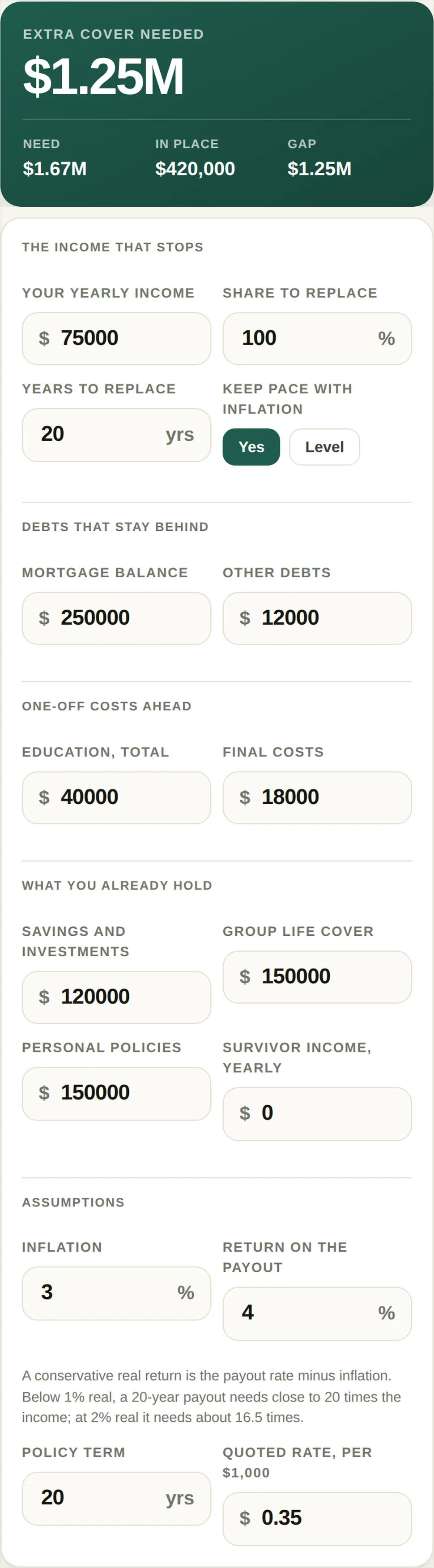
A conservative real return is the payout rate minus inflation. Below 1% real, a 20-year payout needs close to 20 times the income; at 2% real it needs about 16.5 times.
- Income replacement, present value—
- Debts to clear—
- Education—
- Final costs—
- Existing cover and savings—
- Cover as a multiple of income—
- Monthly premium at the quoted rate—
What a life insurance needs calculation actually is
Capital needs analysis answers one question: if the earner died tonight, how much money would the household need on day one so that nothing in its plan had to change? That is a different question from "how much cover can I qualify for", and it is a different question again from "how many times my salary should I buy".
The method is old and unglamorous. List the outflows the household faces, discount the ones that happen later, add the lump sums, then subtract the assets already in place. What remains is the gap, and the gap is what a policy has to fill. Agents call the same arithmetic a needs analysis; the only thing that varies is which lines get included.
How the calculator works, line by line
- Income replacement. Take your gross income, multiply by the share you want replaced, and discount the resulting stream to today. With “keep pace with inflation” on, the discount rate is the real return: payout growth minus inflation. The default pair of 4% and 3% gives roughly 1% real, which is deliberately pessimistic because a survivor will hold cash and bonds, not equities.
- Debts. The mortgage balance and any loans go in at face value. Do not net off home equity unless the plan is to sell the house, and if it is, remember the sale costs about 6–8% of the price.
- Education. Enter the total in today’s dollars for all children. If you have two children and each needs about $40,000 in today’s money, enter $80,000, not $40,000 twice in two different fields.
- Final costs. A funeral runs $8,000–$15,000 in most US markets, and probate, estate administration and the last uncovered medical bills often add more. The default $18,000 is a placeholder you should replace.
- Subtract. Savings, group cover and personal policies come off the top. Group cover is included because it is real, but see the warnings below — the number on the benefits portal is rarely what pays out.
- Turn it into a premium. Quote per $1,000 of cover, times the gap in thousands. A 35-year-old non-smoker in good health often quotes around $0.30–$0.45 per $1,000 a month on a 20-year term; a 45-year-old typically lands at $0.75–$1.10 for the same term.
A worked example: a household with $670,000 in place
Two earners, one of them the primary income at $75,000. Two children aged 6 and 9. Mortgage balance $250,000, car loan and cards $12,000. College savings are funded to about $40,000 in total and the plan is to cover the rest with insurance if the worst happens. Savings and investments $120,000, group cover at the employer $150,000, and a term policy taken out five years ago for $150,000.
Replace the full income for 20 years with inflation protection, at a 1% real return. The present value of $75,000 a year for 20 years is $1,115,811. Add debts of $33,943 including the amortisation effect, college at $341,208 in today’s money, and final costs of $214,883 once inflation is allowed for. Total need: about $1.7 million, or 22.7 times the salary.
Subtract the $670,000 already in place — savings plus both policies — and the gap is $1,035,845. At $0.35 per $1,000 a month that gap costs $363 a month, or $4,352 a year, on a 20-year term. The $750,000 that the ten-times rule would have suggested leaves the household about $280,000 short, roughly four years of income, at exactly the point when the second child is in college.
Where this calculation goes wrong
- Netting off income tax. Replacing gross income over-insures, because the household will not pay the earner’s income tax on the payout. Replacing take-home pay while also ignoring the tax on investment returns under-insures. Pick one convention and stay with it; the default here is gross in, gross out.
- Trusting the group life number. Basic employer cover is often one or two times salary, and it ends when the job ends. If you are 45 with a $150,000 group certificate, that number halves the day you are made redundant, and the replacement policy you then need will be priced for a 45-year-old.
- Double-counting the same dollars. A retirement account that is earmarked to fund retirement cannot also be spent replacing income in the years before retirement. Count it once, in the place where it is actually needed.
- Forgetting that the survivor benefit expires. Social Security survivor benefits for a child stop at 18, or 19 if still in high school. A plan that relies on that income for 20 years has a cliff in it.
- Ignoring underwriting. The premium that matters is the one offered after medical underwriting. A quote at $0.35 per $1,000 assumes preferred health. Raised blood pressure, a BMI over 30, or a treated anxiety diagnosis can move the class.
Term against whole life, for this particular gap
A need that ends when the mortgage is paid and the children leave is a temporary need, and a term policy matches the shape of it. Whole life prices a permanent promise, which is why the same $1 million of cover costs five to fifteen times as much per month. That is not a criticism of permanent cover — it is the right instrument for a dependant with a lifelong disability, for estate liquidity, or for a business succession obligation. It is the wrong instrument for the next twenty years of a mortgage.
The common hybrid is a large term policy sized to the gap, and a much smaller permanent policy for the part of the need that never disappears. Sizing the term layer with this calculator, and not with a multiple, is what stops the permanent layer from being bought too big because the total looked too large.
Privacy
Every number you type stays in this browser tab. There is no submit button that sends anything, no analytics event carrying the figures, and no server-side copy to delete. Close the tab and the calculation is gone. That matters here more than on most calculators, because the inputs are a household’s income, debts and savings in one place.
Questions
Should I use a salary multiple or this calculation?
A multiple is a sales heuristic, not an answer. Ten times a $75,000 salary is $750,000, which may be right or wildly wrong depending on whether you have $400,000 of mortgage left and two children eight years from college. Use the multiple as a sanity check after the line-by-line calculation, and if the two disagree by more than a third, find out which line causes the difference.
Why discount future spending instead of adding it up?
Because a dollar needed in year eighteen can be funded by less than a dollar today. At 3% inflation, $75,000 a year for 20 years adds to $1.5 million if you sum the cheques, but only $1.12 million if you fund it at the start and let it grow. The difference is about a quarter of the number, and quoting the undiscounted figure is the single easiest way to over-insure.
Should I subtract Social Security survivor benefits?
Yes, if you have children under 18 or a spouse caring for them — those benefits are real income. They also stop: the child benefit ends at 18, and the carer benefit can end earlier. Put the survivor figure into the “survivor income” field, and remember to reprice the policy when the benefit stops rather than assuming the need is permanent.
Term or whole life for this amount of cover?
For a need with an end date, term. A gap that closes when the mortgage is paid and the children leave is a temporary need, and term prices that in a way whole life cannot. Whole life is for needs that never end, such as a dependant with a lifelong disability or estate liquidity above the exemption threshold.
Does this replace advice from a licensed agent?
No. It is arithmetic with the assumptions visible so you can argue with them. It does not know your tax position, the underwriting class you will be offered, or the rules in your state or country. Take the printed summary to a licensed adviser and make them explain any figure they change.
What happens if my income changes next year?
Rerun the calculation. Term policies are usually level, so if your income rises you keep the old policy and consider a second layer later; if it falls, you can often reduce coverage at a renewal rather than lapsing. Keeping the breakdown means you can see which line moved instead of guessing at a new round number.
More money tools
Guides
No daily limit on this tool
This one is free with no counter — the arithmetic runs in your browser and costs nothing to serve. All-Access is for the PDF and document tools, which are free three runs a day.
- Unlimited PDF and document jobs
- Full-length output, no page cap
- Every tool added later, included